

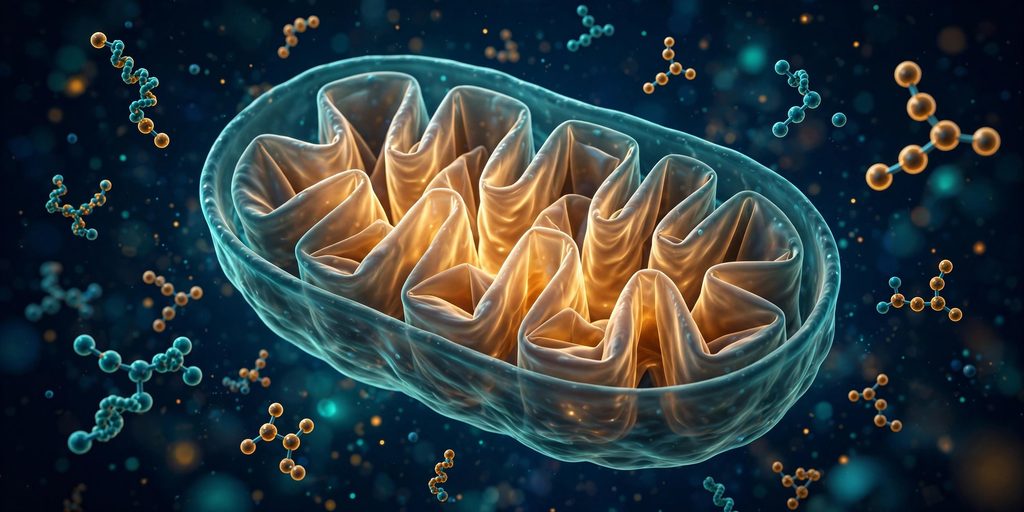
MOTS-c is a 16-amino-acid peptide encoded by your mitochondrial DNA — nicknamed “exercise in a vial” for the way early research suggests it influences metabolism. This guide covers what the research actually says about MOTS-c for weight loss: how it works, what dosage ranges are discussed, its safety picture, and how it compares to other options.
Everything here is for informational purposes. MOTS-c is a research compound, not an approved treatment.
What Is MOTS-c?
MOTS-c (mitochondrial open reading frame of the 12S rRNA-c) is a small peptide made of 16 amino acids, encoded directly in mitochondrial DNA rather than nuclear DNA. First described by researchers in 2015, its discovery revealed that mitochondria do more than produce energy — they send signaling molecules that help regulate whole-body metabolism.
Think of MOTS-c as a messenger your mitochondria use to communicate with the rest of your cells. When cellular energy runs low — during exercise, fasting, or metabolic stress — MOTS-c levels rise and signal cells to shift how they use fuel. That signaling role is exactly why researchers became interested in its potential for obesity and metabolic dysfunction.
The “exercise in a vial” nickname comes from animal research suggesting MOTS-c activates some of the same metabolic pathways that physical exercise does. An exciting concept — but keep perspective: a peptide that mimics some metabolic signals of exercise is not a substitute for exercise, and human research is still in its early stages.
Key facts at a glance
- Structure — 16-amino-acid peptide encoded by mitochondrial DNA
- Discovered — 2015, by researchers studying mitochondrial signaling
- Primary mechanism — activation of the AMPK pathway (explained below)
- Research status — promising animal and early human data; no large-scale human clinical trials for weight loss
- Regulatory status — not FDA-approved for any medical use; sold as a research compound
How MOTS-c Works for Weight Loss

To understand why MOTS-c for weight loss generates so much interest, you need one cellular pathway: AMPK.
The AMPK pathway: your metabolic master switch
AMPK (AMP-activated protein kinase) is an enzyme that acts like a fuel gauge for your cells. When energy is scarce — during a workout, a calorie deficit, or fasting — AMPK switches on and tells your body to burn stored fat for fuel, pull more glucose into muscle cells, and run mitochondria more efficiently.
Early research suggests MOTS-c activates AMPK, essentially flipping that metabolic switch toward fat-burning mode. In animal studies, MOTS-c administration has been associated with increased fat oxidation, improved insulin sensitivity, and resistance to diet-induced obesity in mice fed high-fat diets.
What this could mean for fat loss
Unlike appetite-suppressing compounds such as GLP-1 drugs, MOTS-c doesn’t appear to work by making you eat less. The proposed mechanism is metabolic — helping your body use energy more efficiently and preferentially burn fat. Animal research also indicates it may influence how fat tissue behaves, nudging the body away from storage and toward utilization.
That’s a fundamentally different angle from most weight-loss approaches, and part of the appeal. The honest caveat: nearly all weight-loss evidence comes from animal models. Human data on MOTS-c and body composition is limited, so the real-world fat-loss effect in people remains unproven.
Metabolic flexibility
One of the more interesting concepts in MOTS-c research is metabolic flexibility — the body’s ability to switch smoothly between burning carbs and burning fat depending on availability. Poor metabolic flexibility is associated with insulin resistance and weight gain. By activating AMPK-related pathways, MOTS-c may help support this flexibility — one reason researchers study it in the context of obesity, type 2 diabetes, and age-related metabolic decline.
MOTS-c Benefits Beyond Fat Loss
Weight loss may be the headline, but MOTS-c benefits discussed in the research literature extend further:
- Insulin sensitivity — animal studies indicate MOTS-c may improve how cells respond to insulin, which matters for blood sugar control and metabolic health
- Exercise capacity — some animal research suggests improved physical performance and endurance, consistent with its “exercise mimetic” reputation
- Metabolic health markers — early research has explored MOTS-c in connection with healthier lipid profiles and reduced metabolic stress in animal models
- Healthy aging — endogenous MOTS-c levels appear to decline with age, and researchers have investigated whether restoring them could support healthier aging, though this remains speculative
- Cellular stress resistance — as a mitochondrial stress signal, MOTS-c is part of the body’s broader system for coping with metabolic stress, an active area of longevity research
These findings come primarily from preclinical research. They describe potential, not proven outcomes in humans.
MOTS-c Dosage: What the Research and Community Protocols Suggest

Important: There are no established medical dosing guidelines for MOTS-c. It is not an approved drug, and nothing here is medical advice. What follows summarizes what’s discussed in research protocols and community forums, for informational purposes only.
What the research used
In animal studies, MOTS-c has typically been administered via injection at doses scaled to body weight. These protocols don’t translate directly to humans, and human dosing data is essentially nonexistent in the published literature. This is the single biggest gap in the MOTS-c picture.
Community-reported protocols
In research and biohacker communities, the most commonly discussed MOTS-c dosage protocols fall within these ranges:
- Typical range — 5–10 mg per administration
- Frequency — 1–3 times per week (some protocols use once weekly; others split doses across the week)
- Cycle length — 4–10 weeks, followed by a break
- Common vial size — 10 mg lyophilized powder
Some community members report starting at the lower end (around 5 mg) to assess tolerance before considering higher amounts. Others describe “loading” style approaches with more frequent early doses — though there’s no evidence base for one schedule over another.
Why there’s no definitive answer
Without human clinical trials, every MOTS-c protocol is essentially an educated guess extrapolated from animal research and anecdotal reports. Responsible sources are upfront about this. If you see a site presenting an exact MOTS-c dosage as scientifically established, treat it with skepticism.
Anyone considering research into this compound should consult a qualified healthcare professional and understand that use outside of a laboratory research setting carries unknown risks.
Also read: How to Reconstitute Peptides: The Complete Step-by-Step Guide — dosage math and sterile technique for any lyophilized peptide.
How to Take MOTS-c
MOTS-c is a fragile peptide that breaks down in the digestive tract, so — like most research peptides — it is administered by injection in research settings, not taken orally.
- Reconstitution — MOTS-c typically ships as a lyophilized (freeze-dried) powder that must be reconstituted with bacteriostatic water before use
- Administration — subcutaneous injection (under the skin, typically in the abdomen) is the standard route discussed in research protocols
- Timing — many community protocols suggest morning administration, on the theory that it aligns with the body’s natural metabolic rhythms; this is anecdotal, not evidence-based
- Storage — lyophilized peptides should be stored cool and dark (refrigeration is common); once reconstituted, they generally require refrigeration and have a limited usable life
- Cycling — because long-term effects are unknown, community protocols almost always involve cycling: a defined period of use (often 4–10 weeks) followed by time off, to limit exposure while effects are still being evaluated
MOTS-c Side Effects and Safety
Here’s what can honestly be said about MOTS-c safety: we don’t know much.
- No human clinical trials — have systematically evaluated MOTS-c’s safety profile, side effects, or long-term risks; this is the most important fact in this section
- Anecdotal reports — rarely describe severe reactions; the most commonly mentioned issues are mild and typical of injectable peptides generally, such as temporary redness or irritation at the injection site
- Theoretical concerns — chronically activating AMPK and altering metabolic signaling could have unintended downstream effects, but these are hypothetical, not observed
- Quality risk is real — MOTS-c is sold as an unregulated research chemical, so product purity varies widely between suppliers; contaminated or mislabeled peptides are a genuine safety hazard
The bottom line: MOTS-c appears tolerated in the limited contexts reported so far, but “no news” is not the same as “proven safe.” Always verify third-party testing — see our guide on how to read a peptide COA.
MOTS-c vs Other Weight-Loss Peptides
How does MOTS-c stack up against the better-known options? Here’s a quick comparison:
| MOTS-c | AOD-9604 | Tesamorelin | GLP-1 drugs (semaglutide, tirzepatide) | |
|---|---|---|---|---|
| Mechanism | AMPK activation; metabolic signaling | Modified hGH fragment; targets fat metabolism | GHRH analog; stimulates growth hormone | Gut-hormone mimics; appetite suppression |
| Primary angle | Metabolic efficiency / fat oxidation | Direct fat-loss fragment | Visceral fat reduction | Reduced hunger, slower digestion |
| Evidence level | Animal studies; early human data | Limited human data | FDA-approved (for HIV lipodystrophy) | Extensive clinical trials; FDA-approved |
| Appetite effect | Not primarily | Minimal | Minimal | Strong |
| Regulatory status | Research compound | Research compound | Prescription drug | Prescription drugs |
MOTS-c vs AOD-9604
Both are lesser-known fat-loss peptides, but they work differently — AOD-9604 is a fragment of human growth hormone designed to stimulate lipolysis (fat breakdown) directly, while MOTS-c works upstream on metabolic signaling via AMPK. Some researchers find the combination conceptually interesting, but there’s no clinical evidence for stacking them.
MOTS-c vs tesamorelin
Tesamorelin has the strongest evidence base of the non-GLP-1 options — an FDA-approved drug (for a specific condition) with human trial data showing visceral fat reduction. MOTS-c is earlier-stage and more speculative, but its mitochondrial mechanism is unique.
MOTS-c vs GLP-1s
The big divide: GLP-1 drugs suppress appetite and have robust human trial data, but they’re prescription medications with well-documented side effects and high cost. MOTS-c is a research compound with an intriguing mechanism and essentially no human efficacy data. They’re not really competitors — they represent opposite ends of the evidence spectrum.
Also read: Best Peptides for Weight Loss — our pillar guide to the full landscape.
Frequently Asked Questions
What is MOTS-c?
MOTS-c is a 16-amino-acid peptide encoded by mitochondrial DNA, first described by researchers in 2015. It acts as a metabolic signaling molecule that activates the AMPK pathway, which regulates fat burning, glucose uptake, and energy balance. It’s sold as a research compound and is not FDA-approved for any medical use.
Does MOTS-c actually work for weight loss?
In animal studies, MOTS-c has been associated with increased fat oxidation, improved insulin sensitivity, and resistance to diet-induced obesity. However, there are no large-scale human clinical trials proving it causes weight loss in people. The mechanism is promising but the human evidence is preliminary.
What is a typical MOTS-c dosage?
There are no established medical guidelines. Community-reported research protocols commonly discuss 5–10 mg administered 1–3 times per week, in cycles of 4–10 weeks. These are anecdotal ranges, not recommendations — consult a healthcare professional.
How long does it take to see results with MOTS-c?
There’s no reliable human data on timelines. Community anecdotes vary widely, with some reporting subjective changes in energy or body composition over several weeks. Without clinical trials, any timeline is speculative.
Can you take MOTS-c orally?
No — like most peptides, MOTS-c would be broken down by digestive enzymes before reaching the bloodstream. In research settings it is administered by subcutaneous injection after reconstitution.
Is MOTS-c safe?
Its safety profile in humans has not been systematically studied. Anecdotal reports describe mostly mild injection-site reactions, but long-term risks are unknown. Product quality from unregulated suppliers is an additional real-world risk — always look for third-party COA testing.
Is MOTS-c legal?
MOTS-c is not a controlled substance in most jurisdictions and is sold as a research chemical “for laboratory research use only.” It is not approved for human or veterinary use. Regulations vary by country, so check your local laws.
Ready to explore the research? If MOTS-c has earned a place in your research lineup, source it from a supplier that publishes third-party purity testing on every batch. Browse our tested MOTS-c and metabolic research peptides →
Advanced research: MOTS-c and Mitochondrial Signaling: What the 2015 Discovery Changed — a deeper look at the science behind the peptide.
Medical disclaimer: This article is for informational and educational purposes only and does not constitute medical advice. MOTS-c is not approved by the FDA for any medical use. Products referenced are sold strictly for laboratory research use only and are not intended for human or veterinary consumption. Always consult a qualified healthcare professional before considering any peptide or supplement.
Leave a Reply