
PEPTIDE QUALITY & ANALYTICAL SUPPORT
HPLC Analysis for Peptide Purity & Batch Evaluation
Signalyn Bio uses HPLC analysis as part of peptide quality evaluation to assess chromatographic purity, review impurity profiles, and support batch-specific documentation.
HPLC answers an important quality question—how much of the detected chromatographic signal is associated with the main peptide peak—but it should be interpreted together with identity testing, batch records, and other relevant analytical evidence.
WHAT HPLC TELLS YOU
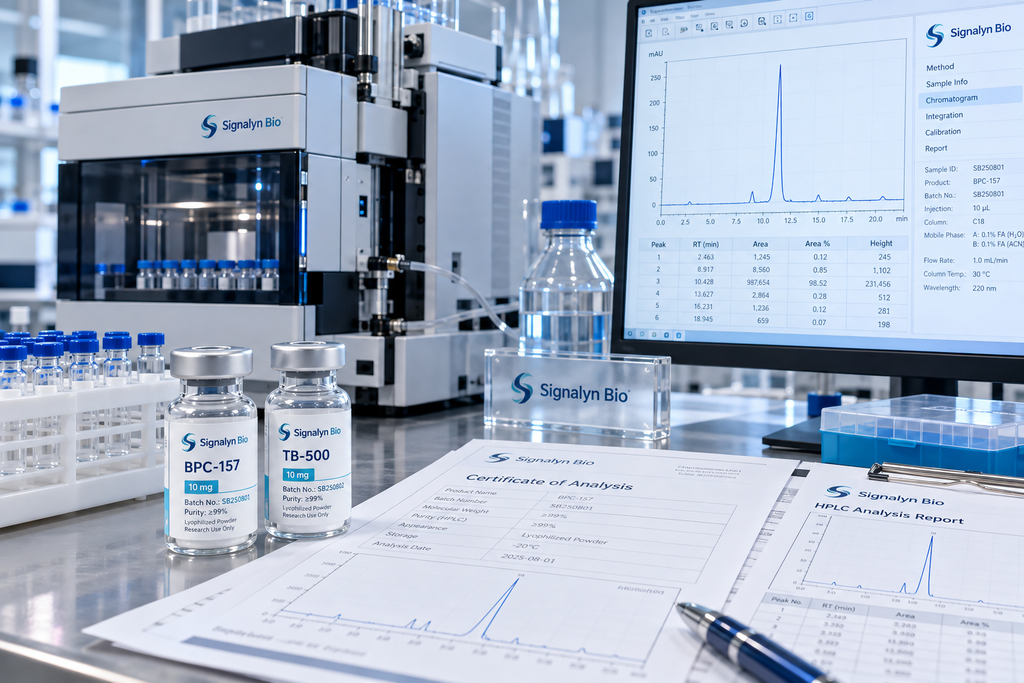
What HPLC Analysis Shows in Peptide Quality Review
High-performance liquid chromatography separates components in a peptide sample and produces a chromatogram that can be reviewed for main-peak area, retention behavior, and detectable secondary peaks.
Chromatographic Purity
Main-peak area percentage can be used to assess chromatographic purity under the stated analytical method and conditions.
Impurity Profile
Secondary peaks can help reveal detectable related substances, synthesis by-products, degradation products, or other chromatographically resolved components.
Batch Comparison
Chromatograms can support batch-to-batch comparison when method conditions, sample preparation, and reporting are sufficiently consistent.
READING THE CHROMATOGRAM
How to Read a Peptide HPLC Chromatogram
A chromatogram should be reviewed as a data record, not as a single headline number. Peak shape, retention time, baseline behavior, integration, method conditions, and secondary peaks all matter when interpreting the result.
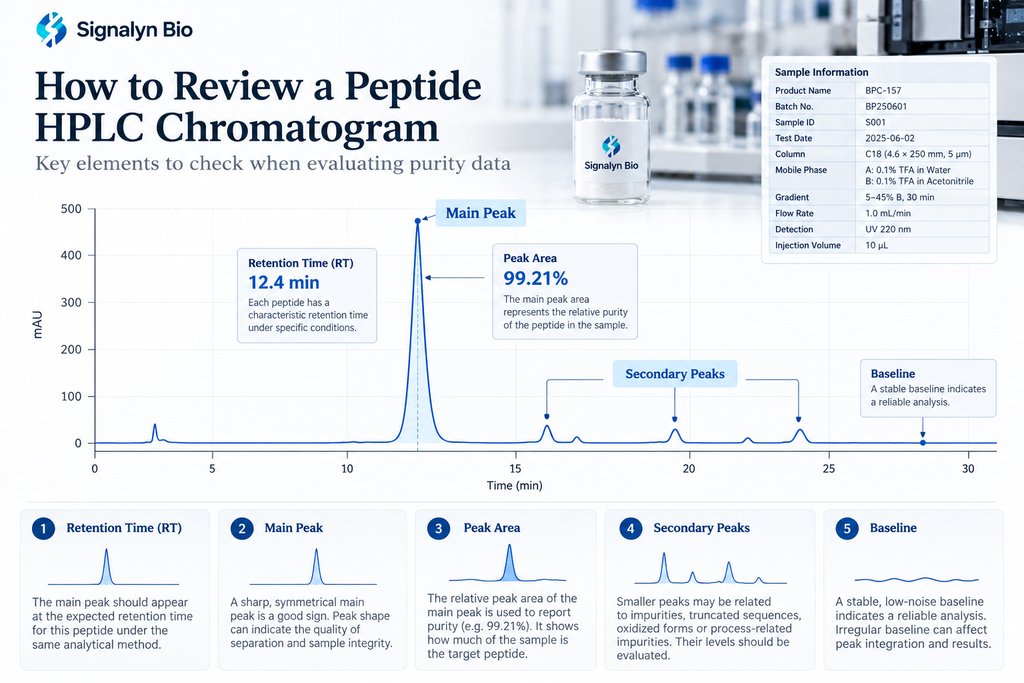
Main Peak
The dominant integrated peak is typically used in area-percent purity calculations when the method is appropriate for the sample.
Retention Time
Retention time can support comparison under defined conditions, but retention time alone should not be treated as definitive molecular identity.
Secondary Peaks
Smaller peaks may represent detectable impurities or related compounds and should be interpreted in the context of the method and integration settings.
For a step-by-step review framework, see our guide to reviewing an HPLC chromatogram.
WHAT HPLC DOES NOT PROVE
Why HPLC Purity Is Only One Part of Peptide Quality
A high HPLC area percentage does not by itself establish complete peptide quality. HPLC purity should be interpreted together with complementary analytical and batch-level evidence.
Identity
HPLC separation does not by itself prove that the main peak is the intended peptide. Molecular identity requires complementary evidence such as mass spectrometry.
Actual Peptide Content
Area-percent purity is not automatically the same as actual peptide content or net peptide amount. Quantitative assay requires an appropriate calibrated method.
Traceability
A chromatogram should be tied to a batch, sample identifier, test date, and supporting documentation to be useful in supplier and quality review.
For the full quality framework, see our Peptide Purity Guide: HPLC addresses chromatographic purity, while identity, content, composition, and traceability require additional evidence.
TYPICAL HPLC WORKFLOW
Typical HPLC Analysis Workflow for Peptide Samples
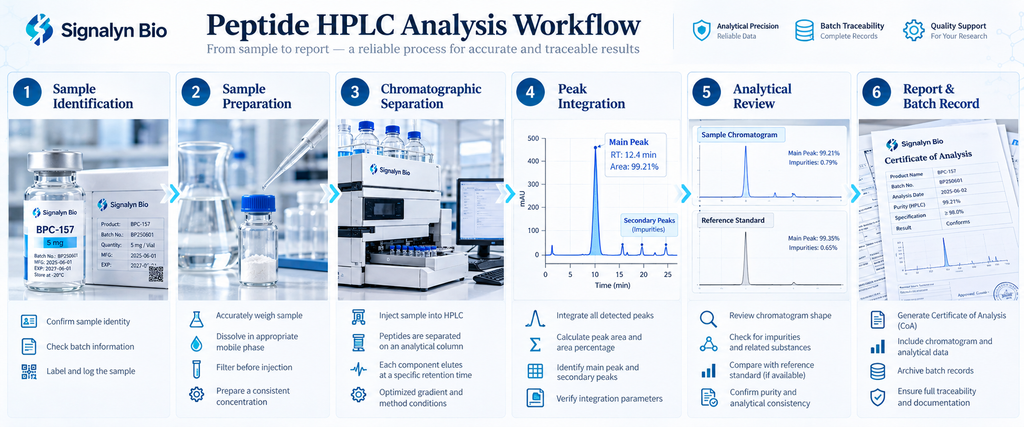
Sample Identification
Record the peptide name, batch or sample ID, requested analytical scope, and relevant project specification.
Sample Preparation
Prepare the peptide sample using a suitable solvent, concentration, and handling procedure for the selected HPLC method.
Chromatographic Separation
Run the sample under defined column, mobile-phase, gradient, flow, temperature, detection, and injection conditions.
Peak Integration
Review the chromatogram, integration boundaries, main peak, secondary peaks, and overall baseline behavior.
Analytical Review
Compare the reported result with the project specification and review any unusual peaks, shoulders, or integration concerns.
Report & Batch Record
Record the analytical result together with sample identification, method information, chromatogram, date, and batch documentation.
ANALYTICAL DOCUMENTATION
What to Look for in an HPLC Report
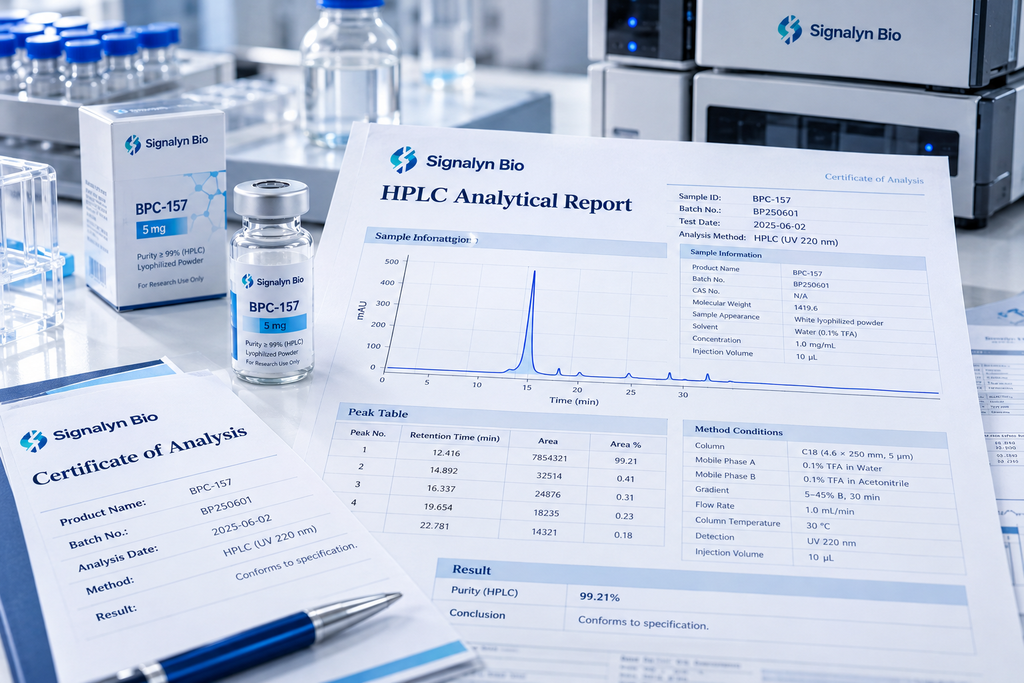
Sample & Batch Identification
The report should clearly identify the sample or batch so the chromatogram can be tied to the material being evaluated.
Method Conditions
Useful reports identify relevant analytical conditions such as column, mobile phase or gradient, flow rate, wavelength, and run conditions where available.
Chromatogram & Peak Table
The chromatogram and peak table provide the context needed to review main-peak area, secondary peaks, retention time, and integration.
HPLC ANALYSIS FAQ
Frequently Asked Questions About Peptide HPLC Analysis
What does HPLC purity mean for a peptide?
It generally refers to the relative chromatographic area of the main detected peak under the stated HPLC method. It should not automatically be interpreted as identity, assay, or total peptide content.
Does 99% HPLC purity prove the peptide is correct?
No. A high main-peak area does not by itself prove molecular identity. Identity should be evaluated with complementary evidence such as mass spectrometry and batch documentation.
What information should an HPLC report include?
Useful records typically include sample identification, test date, chromatogram, peak information, reported purity, and relevant method conditions where available.
Why combine HPLC with mass spectrometry?
HPLC and mass spectrometry answer different questions. HPLC supports purity and separation review, while mass spectrometry supports molecular identity verification.
REQUEST QUALITY DOCUMENTATION
Need HPLC Data for a Peptide Project?
Tell us the peptide, target specification, quantity, analytical requirements, and documentation needs for your project.