
CERTIFICATE OF ANALYSIS & BATCH DOCUMENTATION
Peptide Certificate of Analysis (COA) & Batch Documentation
Signalyn Bio provides batch-specific Certificate of Analysis documentation to summarize peptide identification, reported purity, analytical results, specifications, and other available quality records for research and manufacturing projects.
A COA is most useful when it can be connected to the correct batch and reviewed together with the underlying HPLC chromatogram, mass spectrometry data, and supporting analytical documentation.
WHAT A PEPTIDE COA SHOULD SHOW
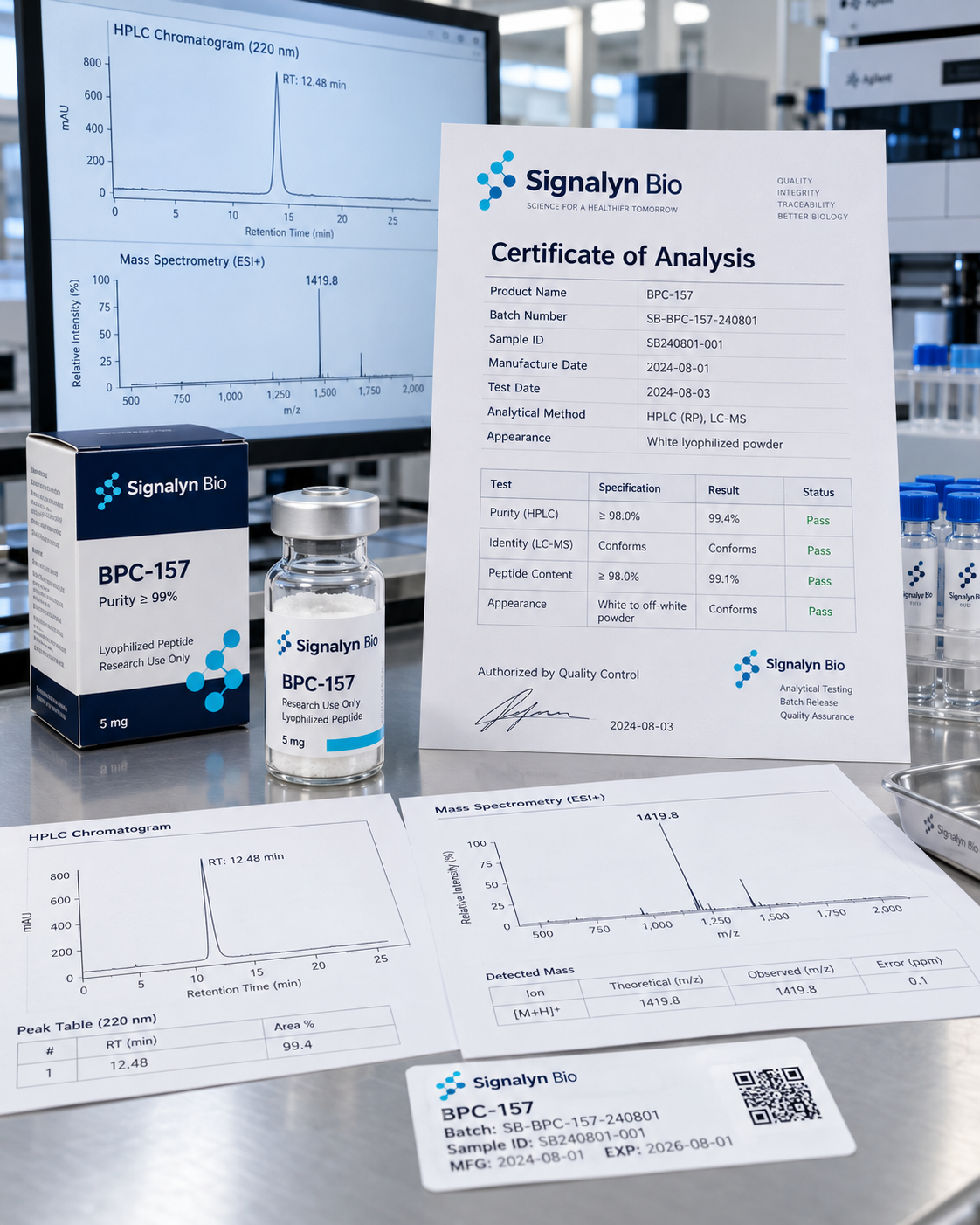
What a Peptide Certificate of Analysis Can Include
The exact COA format can vary by peptide, batch, testing scope, and project requirements, but a useful certificate should make it clear which material was tested and what analytical evidence supports the reported results.
Product & Batch Identification
Peptide name, batch or lot number, sample ID, project reference, and related identifiers help connect the COA to the correct material.
Purity Information
Reported chromatographic purity can be summarized together with the analytical method and batch-specific HPLC result.
Identity Information
Mass spectrometry data can support molecular identity verification by comparing observed mass information with the expected peptide.
Specification Review
Where applicable, reported results can be presented against the agreed project, product, or analytical specification.
Test & Documentation Details
Test date, document date, analytical scope, and other available reporting details can help provide context for the batch record.
Supporting Records
Chromatograms, mass spectra, third-party reports, packaging records, and batch documentation can support deeper quality review.
HOW TO READ A COA
How to Review a Peptide Certificate of Analysis
A COA should be read as a batch-specific summary, not as a standalone marketing certificate. Start by confirming the sample identity and batch, then check whether the reported analytical evidence matches the questions you actually need answered.
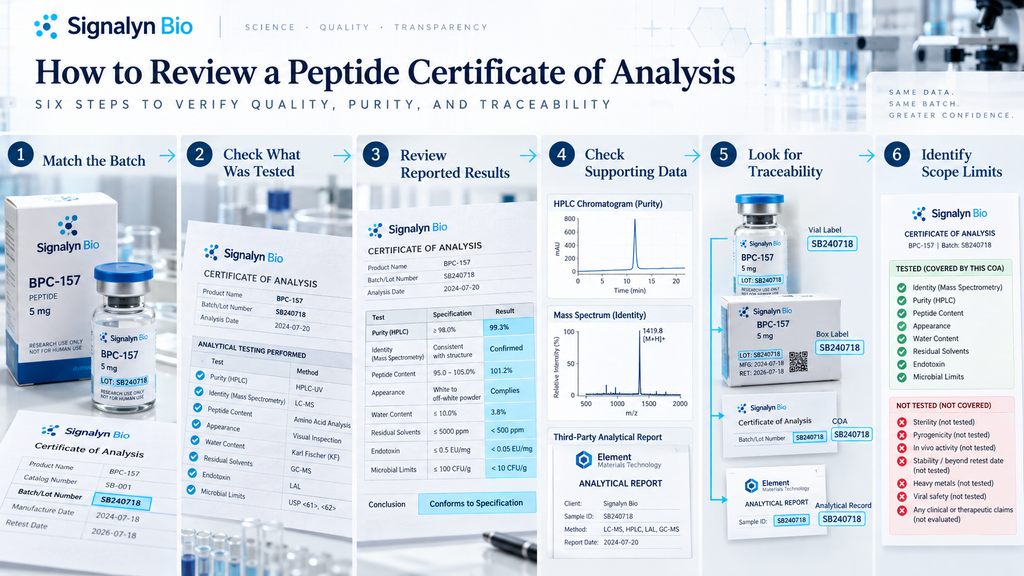
Match the Batch
Confirm that the product name, batch or lot number, and sample identifiers on the COA match the material being evaluated.
Check What Was Tested
Identify which analytical methods were actually performed rather than assuming every quality attribute was measured.
Review the Reported Results
Review purity, identity, specifications, and other listed results in the context of the stated analytical method.
Check Supporting Data
Where deeper review is needed, compare the summary with the underlying chromatogram, mass spectrum, or third-party report.
Look for Traceability
Check whether identifiers remain consistent across the vial or package, COA, analytical records, and project documentation.
Identify What the COA Does Not Prove
Do not infer identity, actual peptide content, sterility, endotoxin, or other attributes unless those items are specifically supported by appropriate testing.
COA VS UNDERLYING ANALYTICAL DATA
A COA Is a Summary—The Analytical Data Provides the Evidence
For procurement or technical review, the most useful documentation package connects the COA with the underlying analytical records rather than relying only on a reported number.
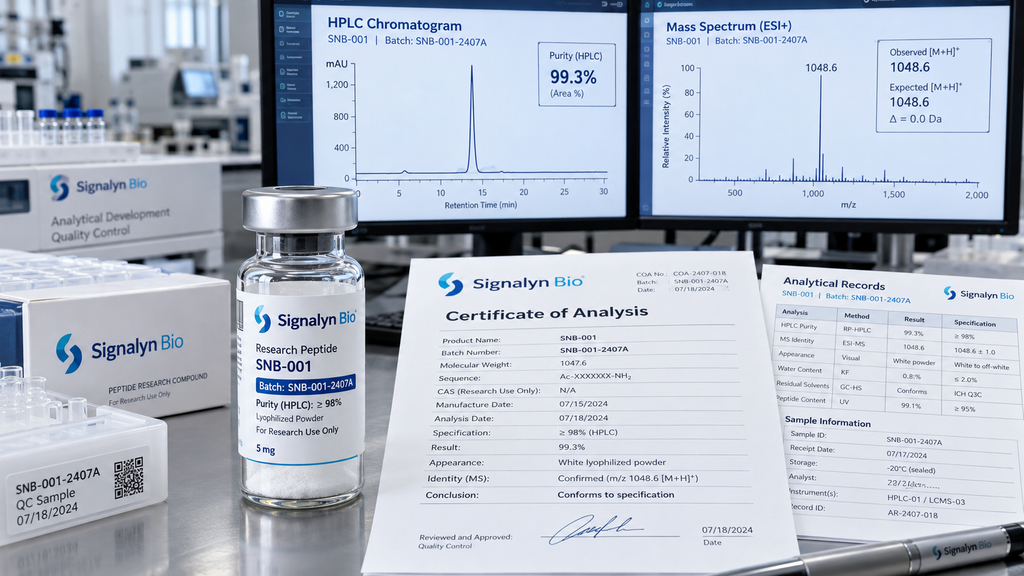
HPLC Chromatogram
Provides the chromatographic profile used to support purity assessment and review of the main and secondary peaks.
Mass Spectrum
Provides mass-related evidence used to support molecular identity verification.
Batch Records
Connect the sample, analytical results, packaging, manufacturing or project records, and final quality documentation.
Important: A reported “99% HPLC purity” is not the same as complete peptide quality. HPLC supports chromatographic purity; molecular identity, actual content, composition, and traceability require additional evidence. Read the Peptide Purity Guide →
COA REVIEW CHECKLIST
Peptide COA Review Checklist for Buyers
Does the COA clearly identify the peptide or material?
Can the document be tied to the exact batch being supplied?
Does the certificate state or support how purity or identity was evaluated?
Is the reported purity connected to HPLC or another stated chromatographic method?
Is molecular identity supported by mass spectrometry or another appropriate method?
Can chromatograms, spectra, or third-party reports be reviewed when needed?
Do batch identifiers remain consistent across documents and supplied material?
Is it clear which attributes were not tested or are outside the COA’s scope?
PEPTIDE COA FAQ
Frequently Asked Questions About Peptide Certificates of Analysis
What is a peptide Certificate of Analysis?
A peptide COA is a batch-specific document that summarizes available analytical results, product and batch identification, specifications, and other quality information for the material being supplied.
What should a peptide COA include?
A useful COA can include product and batch identification, reported purity, identity-related results, specifications, test information, and references to supporting analytical records.
Does a COA prove peptide identity?
Not by itself. Identity should be supported by an appropriate analytical method, such as mass spectrometry, and the result should be tied to the same batch documented on the COA.
Is 99% HPLC purity enough to approve a peptide batch?
No. HPLC purity answers a chromatographic question. Complete review may also require identity, content, composition, traceability, and other project-specific quality evidence.
Can I request the underlying HPLC or mass spectrometry data?
Available supporting analytical records can be discussed according to the batch, testing scope, and project requirements.
Can third-party test reports be reviewed with the COA?
Yes. Independent testing can provide an additional verification layer when a third-party report is available for the same material or batch.
REQUEST COA & ANALYTICAL DOCUMENTATION
Need Certificate of Analysis Information for a Peptide Project?
Share the peptide, batch, quantity, analytical requirements, and documentation needs for your project.