
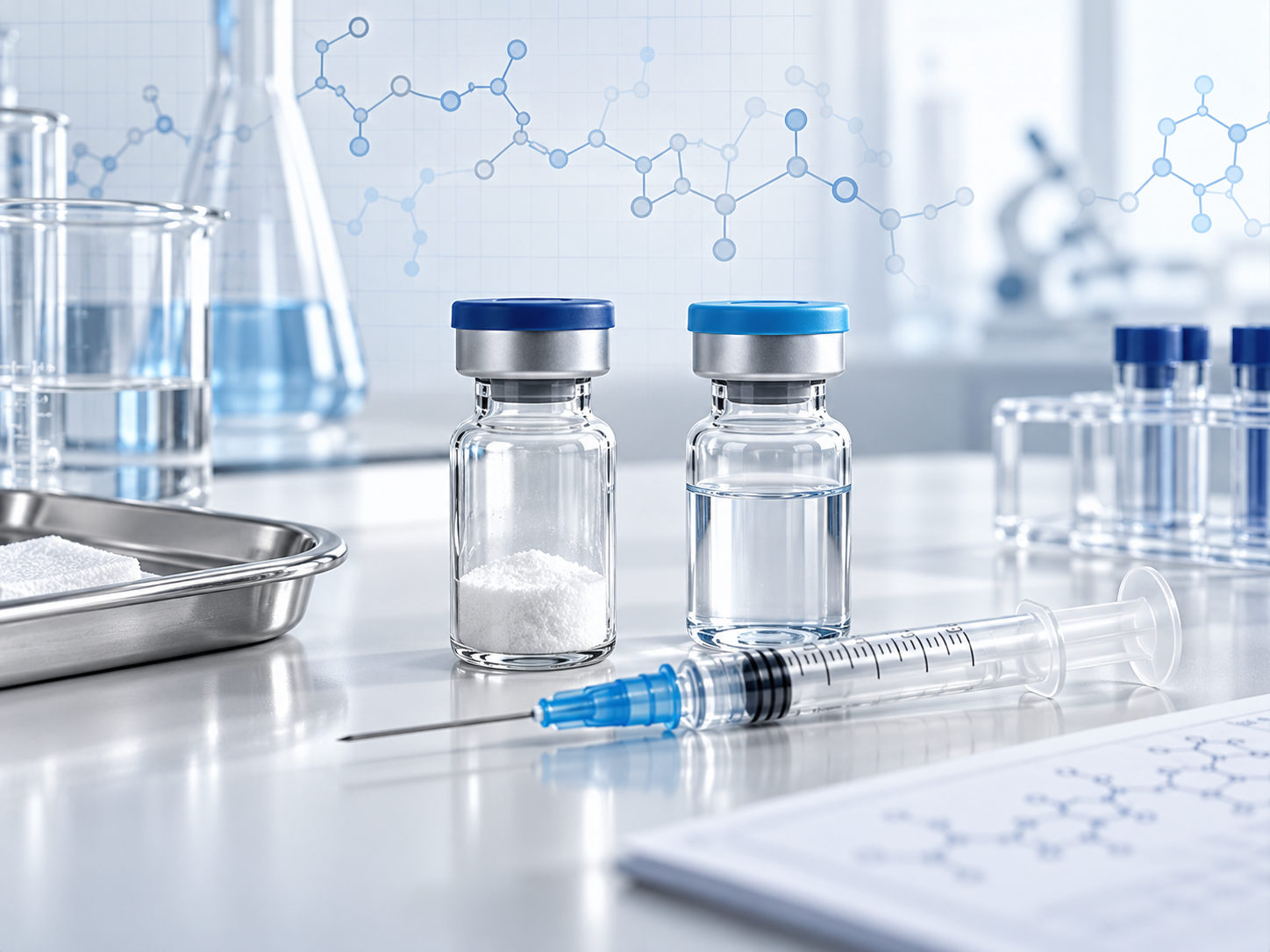
If you’ve just received your first vial of lyophilized (freeze-dried) peptides, you’re probably wondering how to reconstitute peptides correctly. It’s the single most-searched how-to question in the peptide world — and for good reason. Reconstitution is the process of dissolving that little disc of freeze-dried powder at the bottom of the vial into a sterile liquid so it can be measured and used. Done right, it’s simple and takes about five minutes. Done wrong — shaking the vial, using the wrong diluent, or storing it badly — and you can degrade or contaminate an expensive product.
This guide walks you through everything: what reconstitution actually means, the exact supplies you need, numbered step-by-step instructions, dosage math for 5mg and 10mg vials, how long mixed peptides last in the fridge, and the mistakes to avoid. Let’s get into it.
What Does “Reconstitute” Mean?
Peptides are sold as lyophilized powder — the peptide has been freeze-dried into a small white pellet or film at the bottom of a sterile glass vial. Freeze-drying keeps the fragile amino-acid chains stable for months or years without refrigeration.
“Reconstituting” simply means adding a measured amount of sterile liquid (almost always bacteriostatic water) to that vial and gently dissolving the powder into a solution. Once mixed, the peptide is in liquid form and must be refrigerated and used within a limited window — which is why proper technique and storage matter so much.
One important note before we start: peptides sold for research use require sterile technique. You’re working with a product meant to stay free of bacteria and particles. Clean hands, alcohol wipes, and new single-use syringes every time are non-negotiable.
What You’ll Need to Reconstitute Peptides
Gather everything before you open a single vial. Here’s the full checklist:
- Lyophilized peptide vial (e.g., 5mg or 10mg)
- Bacteriostatic water (BAC water) — sterile water containing 0.9% benzyl alcohol, which inhibits bacterial growth so a vial can be used across multiple doses
- Insulin syringes (U-100) — 0.5 mL or 1 mL, 29–31 gauge; you’ll need one syringe for mixing and a fresh one for each dose
- Alcohol prep pads — for wiping vial stoppers
- A clean, flat work surface — wiped down or covered with a clean paper towel
- A marker or label — to write the mixing date on the vial
About the diluent: bacteriostatic water is the standard choice for multi-dose peptide vials because the benzyl alcohol preservative keeps the solution safe across weeks of use. Sterile water for injection (no preservative) is only appropriate for single-use situations. We compare the two in detail below.
How to Reconstitute Peptides: Step-by-Step Instructions
Follow these steps in order. The whole process takes about five minutes, plus a few minutes of resting time for the powder to fully dissolve.
Step 1 — Wash your hands and prepare your surface.
Wash your hands thoroughly with soap and water, or use gloves. Clear a clean, flat surface and lay out all your supplies.
Step 2 — Inspect the peptide vial.
Check that the vial is intact, the seal is unbroken, and the powder inside is dry. If the powder looks discolored, clumpy from moisture, or the seal is broken, don’t use it.
Step 3 — Wipe the vial stoppers with alcohol.
Remove the flip-off caps from both the peptide vial and the bacteriostatic water vial. Wipe the exposed rubber stopper of each vial with an alcohol prep pad and let the alcohol air-dry completely (about 30 seconds). Don’t blow on it or touch the stopper after wiping.
Step 4 — Draw air into the mixing syringe.
Take a fresh insulin syringe, pull the plunger back to draw in a volume of air roughly equal to the amount of bacteriostatic water you plan to add (for example, 2 mL of air for 2 mL of water).
Step 5 — Inject the air into the bacteriostatic water vial.
Push the needle through the stopper of the BAC water vial and inject the air. This equalizes pressure so the water is easy to draw out.
Step 6 — Draw up the bacteriostatic water.
With the needle still in the vial, invert the vial and slowly pull the plunger back to draw up your target volume (commonly 1–3 mL — see the dosage math section below). Remove the syringe and check for large air bubbles; flick the barrel gently and push the plunger slightly to expel them.
Step 7 — Slowly add the water to the peptide vial.
Push the needle through the peptide vial’s stopper, then aim the needle at the inside glass wall of the vial — not directly at the powder. Depress the plunger very slowly, letting the water run down the wall and pool around the powder. A direct high-pressure stream onto the peptide can damage the fragile molecules.
Step 8 — Let it dissolve — don’t shake.
Remove the needle. Never shake a peptide vial. Peptides are delicate chains, and vigorous shaking creates mechanical stress and foaming that can denature them. Instead, gently roll or swirl the vial between your palms until the powder fully dissolves. This usually takes 1–3 minutes. If a few specks remain, let the vial rest in the fridge for 10–15 minutes and swirl again — it should go completely clear.
Step 9 — Label and refrigerate immediately.
Write the peptide name and the mixing date on the vial with a marker. Place it in the refrigerator (2–8°C / 36–46°F) right away — never leave a reconstituted vial at room temperature longer than necessary.
That’s it. Your peptide is reconstituted and ready to be measured into doses with a fresh insulin syringe.
How Much Bac Water for a 5mg or 10mg Vial? (Dosage Math Made Simple)
One of the most common follow-up questions is “how much bac water for a 5mg vial?” The honest answer: any reasonable volume works, because the amount of water doesn’t change your dose — it only changes the concentration. More water means a more diluted solution (easier to measure tiny doses precisely); less water means a more concentrated one (fewer units to inject per dose).
Most people use 1–3 mL of bacteriostatic water. Here’s the math, assuming a standard U-100 insulin syringe where 100 units = 1 mL:
| Vial size | BAC water added | Total solution | Concentration | mcg per unit |
|---|---|---|---|---|
| 2 mg | 1 mL | 100 units | 2 mg/mL | 20 mcg/unit |
| 2 mg | 2 mL | 200 units | 1 mg/mL | 10 mcg/unit |
| 5 mg | 1 mL | 100 units | 5 mg/mL | 50 mcg/unit |
| 5 mg | 2 mL | 200 units | 2.5 mg/mL | 25 mcg/unit |
| 5 mg | 3 mL | 300 units | 1.67 mg/mL | 16.7 mcg/unit |
| 10 mg | 1 mL | 100 units | 10 mg/mL | 100 mcg/unit |
| 10 mg | 2 mL | 200 units | 5 mg/mL | 50 mcg/unit |
| 10 mg | 3 mL | 300 units | 3.33 mg/mL | 33.3 mcg/unit |
Worked example: You have a 5mg vial of BPC-157 and add 2 mL of BAC water. From the table, that’s 25 mcg per unit. If your target dose is 250 mcg, you draw to the 10-unit mark (250 ÷ 25 = 10). If you’d added only 1 mL, the same 250 mcg dose would be just 5 units — harder to measure accurately, which is why 2 mL is the most popular choice for 5mg vials.
Tip: Pick a water volume that makes your typical dose land between 5 and 50 units on the syringe. That range is easy to read and measure precisely.
Bacteriostatic Water vs Sterile Water: Which Should You Use?
This is a frequent point of confusion. Here’s the straight comparison:
| Bacteriostatic water (BAC water) | Sterile water for injection | |
|---|---|---|
| Contains | Sterile water + 0.9% benzyl alcohol | Sterile water only (no preservative) |
| Best for | Multi-dose vials used over days/weeks | Single-use mixing |
| Bacterial protection | Benzyl alcohol inhibits bacterial growth after the vial is punctured | None — once opened, contamination risk rises quickly |
| Slight sting? | Can sting mildly for sensitive individuals due to benzyl alcohol | Generally sting-free |
Bottom line: For reconstituting peptides that you’ll use across multiple doses over several weeks, bacteriostatic water is the correct choice. The benzyl alcohol preservative is what keeps a repeatedly punctured vial safe. Sterile water without preservative is fine only if you’ll use the entire vial in one sitting — otherwise, discard the remainder rather than storing it.
One caution: never use tap water, distilled water from the grocery store, or homemade saline. Only use sealed, medical-grade bacteriostatic or sterile water.
How Long Do Reconstituted Peptides Last?
Once mixed, the clock starts ticking. The widely used rule of thumb is:
- Reconstituted peptides with bacteriostatic water, refrigerated at 2–8°C: use within 28–30 days.
This 30-day window is the standard guidance you’ll see from peptide manufacturers and compounding pharmacies. Some hardier peptides may remain viable longer, and some especially fragile ones degrade faster, but 30 days refrigerated is the safe, conservative cutoff most researchers follow.
Signs your reconstituted peptide may have degraded: – The solution becomes cloudy or develops visible particles (it should be crystal clear) – Discoloration (yellowing or darkening) – It has been stored longer than 30 days, even if it looks fine
When in doubt, discard it. Peptides are too expensive — and degraded product too unreliable — to gamble on.
For maximum potency within that window: keep the vial refrigerated at all times, minimize the time it spends at room temperature, protect it from light (store it in its box or a dark spot in the fridge), and never return a used syringe to the vial.
Can You Freeze Reconstituted Peptides?
Short answer: it’s not recommended.
While freezing is excellent for unmixed lyophilized powder (many researchers store sealed powder vials in the freezer for long-term storage), freezing a reconstituted liquid peptide is a different story. Freeze–thaw cycles can damage the peptide’s molecular structure, and ice crystal formation in solution accelerates degradation. Most manufacturers explicitly advise against it.
If you’re facing a situation where a reconstituted vial won’t be used within 30 days, the better options are:
- Mix smaller vials so nothing goes to waste — buy the vial size that matches your research timeline.
- Keep it refrigerated and use it within the 30-day window.
- If you absolutely must extend storage, a single careful freeze is less harmful than repeated freeze–thaw cycles — but expect some potency loss, and this is a compromise, not best practice.
The cleanest strategy: freeze the powder, refrigerate the solution. Unopened lyophilized vials store well in the freezer for extended periods; once you add water, the vial lives in the fridge and gets used within a month.
How to Reconstitute Peptides: Common Mistakes to Avoid
- Shaking the vial. The #1 mistake. Always swirl gently — never shake, vortex, or agitate vigorously.
- Spraying water directly onto the powder. Aim for the glass wall and let the water flow down gently. Direct pressure can damage peptide chains.
- Using the wrong diluent. Tap water, non-sterile water, or expired BAC water can introduce bacteria or contaminants. Use only sealed, medical-grade bacteriostatic water for multi-dose vials.
- Skipping the alcohol wipe. Every vial puncture should start with a wiped, air-dried stopper. This is basic sterile technique.
- Reusing syringes. A fresh, sterile syringe for every draw. Reused needles dull, introduce contamination, and risk coring the stopper.
- Leaving the mixed vial at room temperature. Reconstituted peptides belong in the fridge (2–8°C). Room-temperature storage accelerates degradation significantly.
- Not labeling the vial. Write the peptide name and mix date on every vial. Unlabeled vials in a shared fridge are an accident waiting to happen.
- Trying to “save” an expired vial. Past ~30 days refrigerated, or showing cloudiness/particles — discard it. Don’t try to stretch it.
Storage Guide: Powder vs Reconstituted (Quick Reference)
| Form | Where to store | Temperature | Typical shelf life | Notes |
|---|---|---|---|---|
| Lyophilized powder, sealed | Freezer (best) or fridge | −20°C frozen, or 2–8°C | Up to ~2 years frozen; 12+ months refrigerated | Keep away from light and moisture; don’t open until ready to mix |
| Lyophilized powder, opened but unused | Refrigerator | 2–8°C | Use promptly once the seal is broken | Reseal and refrigerate; mix soon |
| Reconstituted solution | Refrigerator only | 2–8°C | Up to 30 days | Label with mix date; discard if cloudy or past 30 days |
| Reconstituted solution | Freezer | — | Not recommended | Freeze–thaw damages peptides; freeze powder instead |
Frequently Asked Questions
How much bacteriostatic water do I add to a 5mg vial?
Most people use 2 mL, which gives 25 mcg per unit on a U-100 insulin syringe — easy math for typical doses. 1 mL (50 mcg/unit) works if you prefer fewer units per dose, and 3 mL (16.7 mcg/unit) gives the most precise measurement for very small doses. The water volume doesn’t change your dose, only the concentration.
How long do reconstituted peptides last in the fridge?
Up to 30 days when mixed with bacteriostatic water and stored at 2–8°C. Discard the vial if the solution turns cloudy, develops particles, changes color, or passes the 30-day mark.
Can you freeze reconstituted peptides?
It’s not recommended. Freeze–thaw cycles can degrade the peptide’s structure. Freeze unmixed lyophilized powder for long-term storage instead, and keep reconstituted vials refrigerated for up to 30 days.
Can I use sterile water instead of bacteriostatic water?
Only for single-use situations. Sterile water has no preservative, so a punctured vial isn’t protected against bacterial growth. For any multi-dose vial used over days or weeks, bacteriostatic water is the correct choice.
What happens if I accidentally shake the vial?
A brief accidental shake isn’t an automatic death sentence for the peptide, but make it a habit to avoid it. Let the vial rest in the fridge, check that the solution is clear with no excessive foaming, and handle it gently from there. Repeated or vigorous shaking is what causes real damage.
Do peptides need to be refrigerated before mixing?
Unmixed lyophilized powder is stable at cool room temperature short-term, but refrigeration (or freezing) extends its life significantly. Once mixed, refrigeration at 2–8°C is mandatory.
How long does lyophilized peptide powder last unmixed?
Sealed powder vials typically last up to around two years in the freezer, or 12 months or more in the refrigerator, kept dark and dry. Always check the vial for moisture damage or discoloration before mixing.
Can I mix two different peptides in one vial?
It’s generally not advised unless you have a specific, well-established protocol. Different peptides can interact or degrade at different rates in solution. Most researchers reconstitute each peptide in its own vial.
Ready to mix? Get pharmaceutical-grade bacteriostatic water, sterile insulin syringes, and alcohol prep pads — everything in the checklist above — in our reconstitution supply kit. All peptides are sold strictly for laboratory research use.
Disclaimer: This guide is for informational purposes only and is intended for laboratory research use. It is not medical advice. Peptides discussed here are sold as research chemicals not for human consumption. Always follow sterile laboratory technique and consult applicable regulations in your jurisdiction.
Leave a Reply