
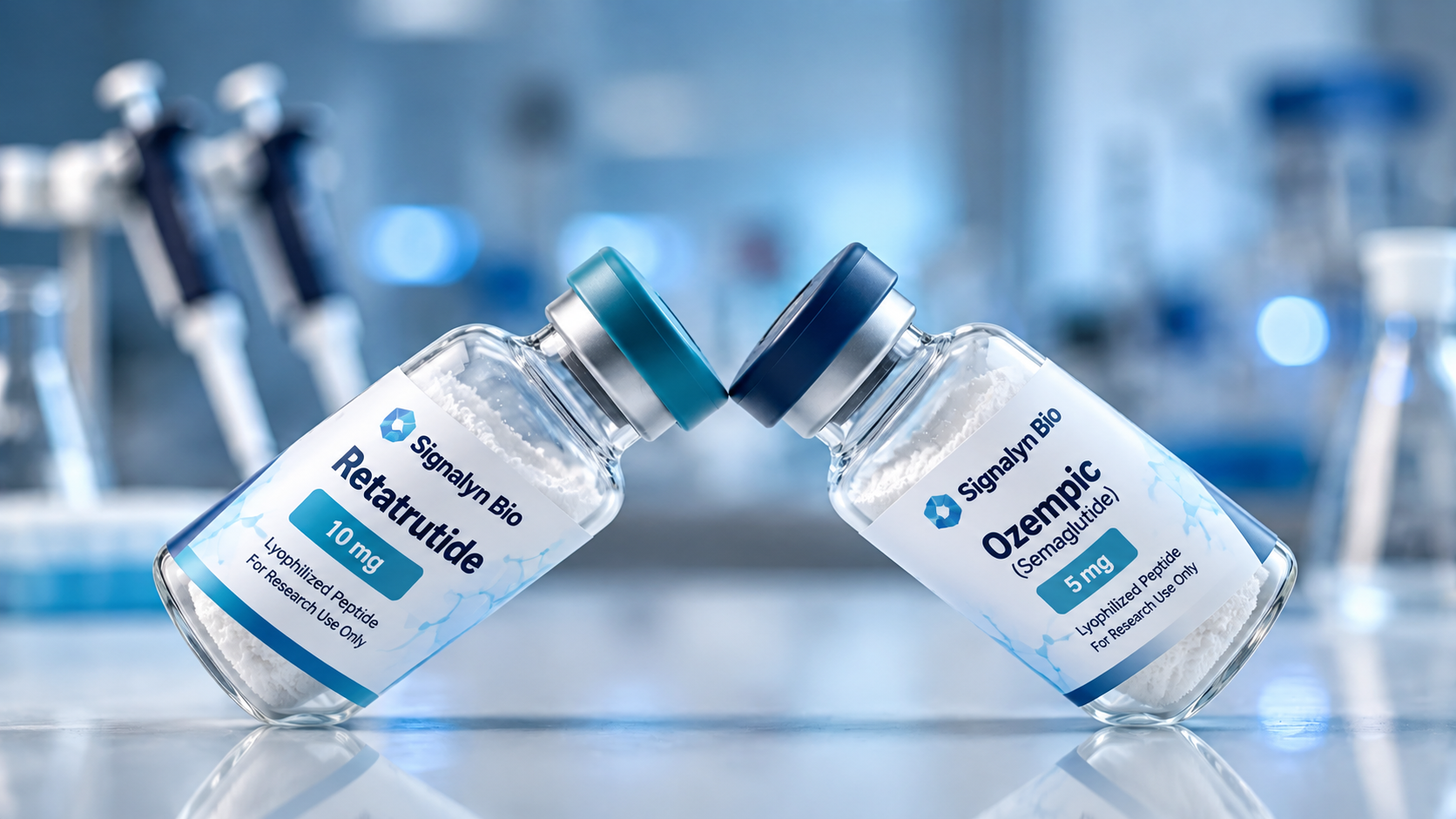
Two names dominate every metabolic peptide conversation right now: retatrutide, Eli Lilly’s investigational triple agonist posting unprecedented trial numbers, and Ozempic (semaglutide), the GLP-1 drug that started the modern weight-loss era. They are not in the same category — one is an approved medicine, the other is still in clinical trials. This retatrutide vs ozempic comparison breaks down the mechanisms, what the trials actually show, and which compound fits your research context.
The Short Answer
- Retatrutide — a triple receptor agonist (GIP + GLP-1 + glucagon) still in Phase 3 trials. In the 80-week TRIUMPH-1 trial, the 12 mg dose averaged 28.3% weight loss vs 2.2% for placebo (efficacy estimand, Lilly topline) — the largest reduction reported in any obesity drug trial to date.
- Ozempic — semaglutide, a single GLP-1 receptor agonist FDA-approved since 2017 for type 2 diabetes. Its higher-dose sibling Wegovy (2.4 mg) averaged 14.9% weight loss at 68 weeks in the STEP-1 trial vs 2.4% for placebo.
- The honest caveat — these numbers come from different trials with different populations, durations, and statistical methods. They are not head-to-head results, and this article treats them that way throughout.
Now the full retatrutide vs ozempic breakdown.
What Is Retatrutide?
Retatrutide (development code LY-3437943) is an investigational once-weekly injectable developed by Eli Lilly. It is the first triple agonist in its class, activating three hormone receptors at once: GIP (glucose-dependent insulinotropic polypeptide), GLP-1 (glucagon-like peptide-1), and glucagon. The rationale: GLP-1 suppresses appetite, GIP may amplify that effect and improve tolerability, and glucagon receptor activation increases energy expenditure — attacking weight from three directions instead of one.
As of October 2026, retatrutide is not FDA-approved. It has completed several Phase 3 trials in Lilly’s TRIUMPH program, and the company has guided toward a regulatory submission for obesity in Q1 2027. Everything below about retatrutide comes from published or company-reported clinical trial data — not from an approved product label.
What Is Ozempic?
Ozempic is the brand name for semaglutide, a once-weekly GLP-1 receptor agonist developed by Novo Nordisk. It was FDA-approved in December 2017 for adults with type 2 diabetes (alongside diet and exercise), with a later indication for reducing major cardiovascular events in that population. It is one of the most prescribed metabolic drugs in the world.
One clarification that matters for this comparison: Ozempic is not approved for weight loss. The same molecule at a higher dose is sold as Wegovy (2.4 mg weekly), which is FDA-approved for chronic weight management. When this article cites weight-loss trial data for semaglutide, it uses the Wegovy 2.4 mg STEP trials — the appropriate reference — and labels Ozempic’s own data (from diabetes trials) separately.
Retatrutide vs Ozempic: Side-by-Side Comparison
| Retatrutide | Ozempic (semaglutide) | |
|---|---|---|
| Drug class | Triple agonist (GIP / GLP-1 / glucagon) | Single GLP-1 receptor agonist |
| Manufacturer | Eli Lilly | Novo Nordisk |
| Approval status | Investigational; obesity filing expected Q1 2027 | FDA-approved Dec 2017 for type 2 diabetes |
| Administration | Once-weekly subcutaneous injection (trial doses 4–12 mg) | Once-weekly subcutaneous injection (0.25 → 0.5 → 1 → 2 mg titration) |
| Trial weight loss | Up to 28.3% at 80 weeks (TRIUMPH-1, 12 mg, efficacy estimand) | 14.9% at 68 weeks (STEP-1, Wegovy 2.4 mg) |
| Main side effects | GI events (nausea, diarrhea, vomiting), dose-dependent | GI events (nausea, vomiting, diarrhea, constipation); boxed warning for thyroid C-cell tumors (rodent data) |
Cross-trial figures shown for scale only — see the methodology note below.
How They Work: Triple Agonist vs GLP-1 Alone

The mechanistic difference is the whole story behind the efficacy gap:
- GLP-1 activation (both drugs) — slows gastric emptying, suppresses appetite via brain signaling, and improves glycemic control. This is the shared foundation.
- GIP activation (retatrutide only) — may enhance appetite suppression and is hypothesized to improve tolerability of GLP-1 effects; it is also the second pathway in Lilly’s already-approved tirzepatide.
- Glucagon receptor activation (retatrutide only) — increases energy expenditure and fat metabolism. This is retatrutide’s distinctive third lever — no approved obesity drug currently targets it.
In practical terms, Ozempic pulls one well-understood lever very effectively. Retatrutide pulls three at once — which explains both the larger trial numbers and the more complex tolerability profile discussed below.
Weight Loss: What the Trials Actually Show
Read this first: no head-to-head trial of retatrutide vs Ozempic (or vs Wegovy) has been conducted. The figures below come from separate trials with different populations, durations, and statistical methods (estimands). Treat them as order-of-magnitude context, not as a ranking. Keep this methodology note in mind whenever you see a retatrutide vs ozempic efficacy claim online.

Retatrutide trial data
- Phase 2 (NEJM 2023, Jastreboff et al.) — 48 weeks, 338 adults with obesity and without diabetes. The 12 mg weekly dose averaged −24.2% body weight vs −2.1% for placebo at 48 weeks (least-squares mean, efficacy estimand).
- TRIUMPH-1 (Phase 3, obesity without diabetes) — 80 weeks, 2,339 adults. The 12 mg dose averaged −28.3% (70.3 lb) vs −2.2% for placebo (efficacy estimand, Lilly topline, May 2026); 65.3% of participants on 12 mg reached a BMI below 30. Note: the subsequently published abstract reported −25.0% vs −3.9% under a different estimand — same trial, different statistical lens.
- TRIUMPH-2 (Phase 3, obesity with type 2 diabetes) — 80 weeks, 1,152 adults. The 12 mg dose averaged −20.8% (efficacy estimand) or −18.8% (treatment-regimen estimand) vs placebo — a textbook example of why the estimand matters when quoting a single number. A1C fell 1.4–1.6 percentage points across dose groups.
- TRIUMPH-3 (Phase 3, severe obesity with established cardiovascular disease) — 80 weeks, 1,949 adults. The 12 mg dose averaged −22.6% vs −3.2% for placebo, alongside improvements in triglycerides (−37.0%), systolic blood pressure (−9.3 mmHg), and hsCRP (−51.2%).
Semaglutide trial data
- STEP-1 (Wegovy 2.4 mg, NEJM 2021) — 68 weeks, 1,961 adults with obesity and without diabetes. Average weight change −14.9% vs −2.4% for placebo (treatment difference −12.4 percentage points). This is the correct benchmark for semaglutide’s weight-management efficacy.
- SUSTAIN-1 (Ozempic 1 mg, diabetes population) — 30 weeks in adults with type 2 diabetes. The 1 mg group lost 3.5 kg more than placebo. Ozempic’s own trials were designed around glycemic control, not weight loss — which is exactly why it carries no weight-loss indication.
Bottom line on efficacy: in their respective trials, retatrutide’s weight reductions (roughly 21–28% at the top dose across TRIUMPH trials) were substantially larger than semaglutide 2.4 mg’s 14.9% in STEP-1. The triple-agonist mechanism appears to deliver more — at the cost, so far, of a steeper tolerability curve.
Side Effects Compared
Both compounds share the classic incretin side-effect profile — gastrointestinal events that are worst during dose escalation and tend to ease over time. The differences are in intensity and in Ozempic’s unique boxed warning:
- Retatrutide — GI events are clearly dose-dependent. In TRIUMPH-2, nausea ranged from 13.7% (4 mg) to 28.0% (12 mg); diarrhea from 27.4% to 33.6%. Discontinuation due to adverse events ran 3.8%–11.6% across doses (vs 4.9% placebo), reaching ~13.5% at the top dose in TRIUMPH-3. Most events were mild-to-moderate and concentrated in the escalation phase.
- Ozempic — the FDA label lists nausea, vomiting, diarrhea, abdominal pain, and constipation (each ≥5%) as the most common adverse reactions, with GI events in 32.7–36.4% of patients on therapeutic doses. Separately, semaglutide carries a boxed warning for thyroid C-cell tumors observed in rodents (human relevance unknown) — it is contraindicated in patients with a personal or family history of medullary thyroid carcinoma or MEN 2. Other labeled serious risks include pancreatitis and gallbladder disease.
Neither profile is “mild” — but they are different kinds of concern: retatrutide’s is about tolerability at high doses, Ozempic’s includes a rare but serious labeled risk that shapes prescribing decisions.
Approval Status and Availability
- Ozempic is a prescription medicine — approved, manufactured, and dispensed through normal pharmaceutical channels for type 2 diabetes since 2017.
- Retatrutide is not available as a medicine. It exists today only as an investigational compound in clinical trials and as a research-grade peptide supplied for laboratory use. Any “retatrutide” sold outside a trial is, by definition, not the approved drug — because no approved drug exists yet.
- What this means for researchers: sourcing decisions for retatrutide hinge entirely on analytical quality — identity confirmation by mass spectrometry, purity by HPLC, and batch-level documentation — since there is no FDA-approved manufacturing standard to fall back on.
Which One Fits Your Research?
- Studying multi-receptor metabolic pharmacology — retatrutide is the more interesting tool: three pathways, dose-ranging data, and an active Phase 3 program generating new readouts.
- Studying established GLP-1 biology — semaglutide has nearly a decade of real-world and trial data, well-characterized pharmacokinetics, and the deepest literature base of any peptide in this space.
- Comparing mechanisms — the pair makes a natural contrast (single vs triple agonism), which is precisely why “retatrutide vs semaglutide” has become one of the most searched comparisons in the field.
Also read: our retatrutide product page lists available purities, analytical documentation, and third-party testing for research-grade material.
Frequently Asked Questions
Is retatrutide better than Ozempic?
In the retatrutide vs ozempic debate, the trial numbers favor retatrutide for weight reduction — but the trials differed in population, duration, and design, so this is not a head-to-head conclusion. Ozempic is an approved medicine with a decade of safety data; retatrutide is investigational. “Better” depends entirely on the question being asked.
Is Ozempic the same as semaglutide?
Yes. Ozempic is the brand name; semaglutide is the molecule. The same molecule is also sold as Wegovy (2.4 mg, approved for weight management) and Rybelsus (oral tablet, approved for type 2 diabetes).
What is retatrutide?
Retatrutide (LY-3437943) is Eli Lilly’s investigational triple agonist targeting GIP, GLP-1, and glucagon receptors, administered as a once-weekly injection in trials. It is not FDA-approved as of 2026.
When will retatrutide be approved?
Lilly has guided toward submitting retatrutide for FDA approval in obesity in Q1 2027. Timelines for investigational drugs frequently shift; treat any date as guidance, not a commitment.
Can you switch from Ozempic to retatrutide?
Retatrutide is not an approved medicine, so there is no labeled switching protocol. In clinical practice, switching between approved incretin drugs is a decision for a prescribing physician. This article does not provide medical guidance.
Why is retatrutide not FDA approved yet?
It is still completing the Phase 3 TRIUMPH program. Drug approval requires the full trial package plus FDA review — typically a multi-year process even after positive readouts.
Need research-grade retatrutide with verified purity? We hope this retatrutide vs ozempic comparison helps frame your sourcing decision. Browse our retatrutide collection — every batch ships with HPLC and mass spectrometry documentation, plus third-party COA verification.
Advanced research: Retatrutide vs Tirzepatide — how Lilly’s triple agonist compares to its dual-agonist predecessor, and what the TRIUMPH and SURMOUNT trials reveal about multi-receptor weight-loss pharmacology.
Disclaimer: This article is for informational and educational purposes only and does not constitute medical advice. Retatrutide is an investigational compound that has not been approved by the FDA; all efficacy and safety figures cited are from clinical trials. Peptides sold on this site are for laboratory research use only and are not intended for human or veterinary use. Consult a qualified healthcare professional for medical decisions.
Leave a Reply