
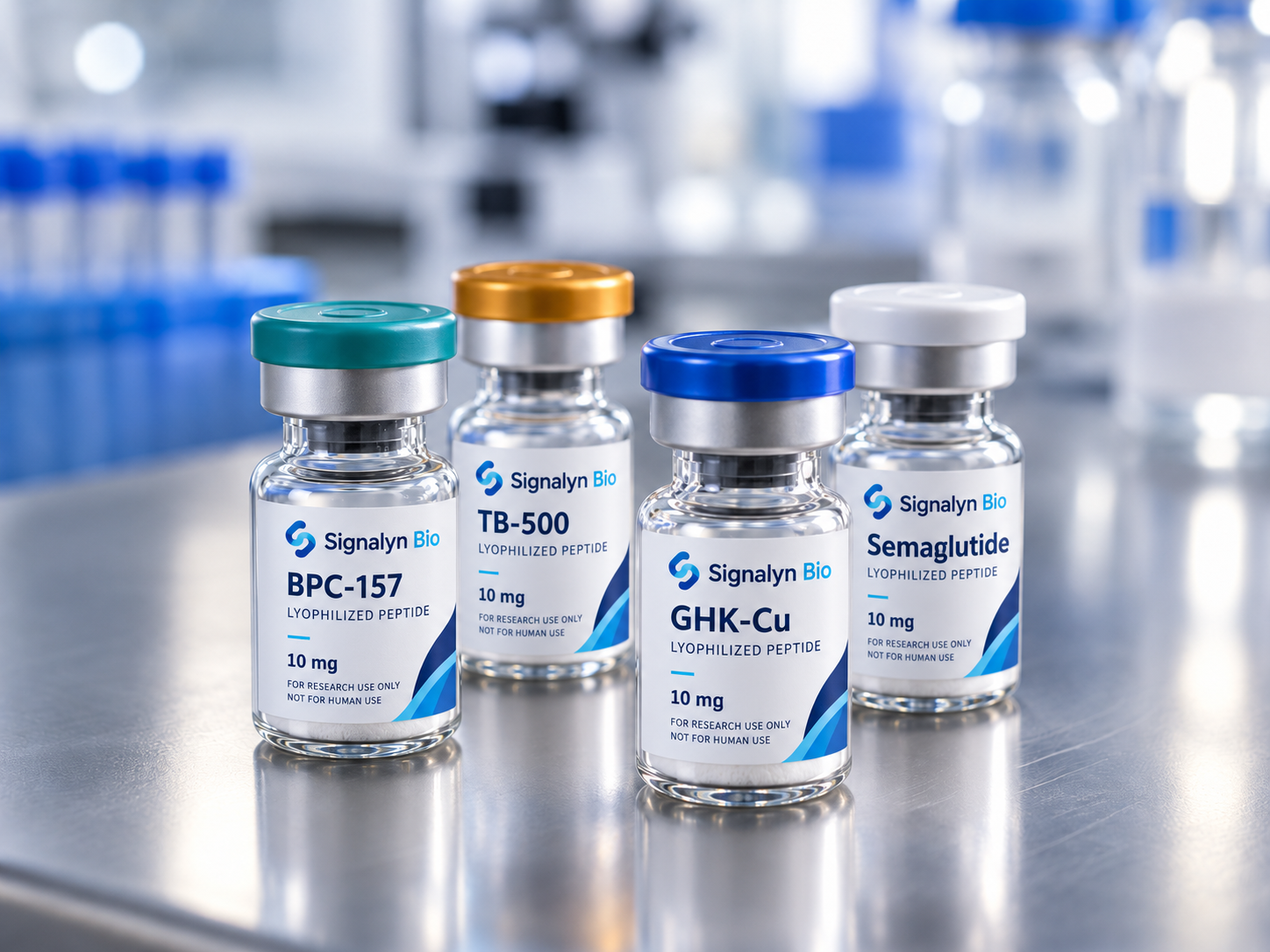
Klow is the peptide world’s four-in-one bundle: GHK-Cu, BPC-157, TB-500, and KPV combined in a single vial, marketed as a complete repair-and-recovery research stack. It has enthusiastic fans, vendor dosage charts, and bold synergy claims — and zero published studies on the blend itself. This guide separates what each ingredient’s research actually shows from what the blend’s marketing implies, explains why no legitimate Klow protocol exists, and shows how to evaluate a supplier if you’re sourcing the blend for research.
The Short Answer
- Klow — a vendor-created 4-peptide blend (GHK-Cu 50 mg + BPC-157 10 mg + TB-500 10 mg + KPV 10 mg per 80 mg vial). It evolved from the earlier “Glow” three-peptide blend with KPV added. The name has no clinical or regulatory meaning.
- What the research shows — each component has its own preclinical literature (skin, gut, tissue-repair, and inflammation models), but no published study has tested the four together. Every “Klow benefit” claim you’ve read is extrapolated from single-peptide studies, not blend data.
- The honest caveat — the only controlled combination study in this space (BPC-157 + TB-500, Biçer et al. 2026) found the combo no better than either peptide alone. “Synergy” is a marketing word until a trial proves it.
What Is the Klow Peptide Blend?
Klow (sometimes written “KLOW”) is a research-use blend of four peptides co-lyophilized in one vial. The formulation most vendors converge on is:
| Component | Amount per vial | Share | What it is |
|---|---|---|---|
| GHK-Cu | 50 mg | 62.5% | Copper-binding tripeptide |
| BPC-157 | 10 mg | 12.5% | 15-amino-acid gastric peptide |
| TB-500 | 10 mg | 12.5% | Thymosin beta-4 fragment (see identity note below) |
| KPV | 10 mg | 12.5% | α-MSH-derived tripeptide |
| Total | 80 mg | 100% |
Three things to understand about this table. First, the 50/10/10/10 ratio is a market convention, not a standard — there is no pharmacopeia monograph, no regulatory filing, and no clinical rationale published for these proportions. Vendors copied each other. Second, Klow grew out of “Glow” (GHK-Cu + BPC-157 + TB-500); KPV was added later as the fourth ingredient, which is why older content may describe a three-peptide version. Third, the name itself is vendor slang — it appears in no medical literature and means nothing outside the research-peptide market.
What’s Inside: The Four Peptides and Their Research
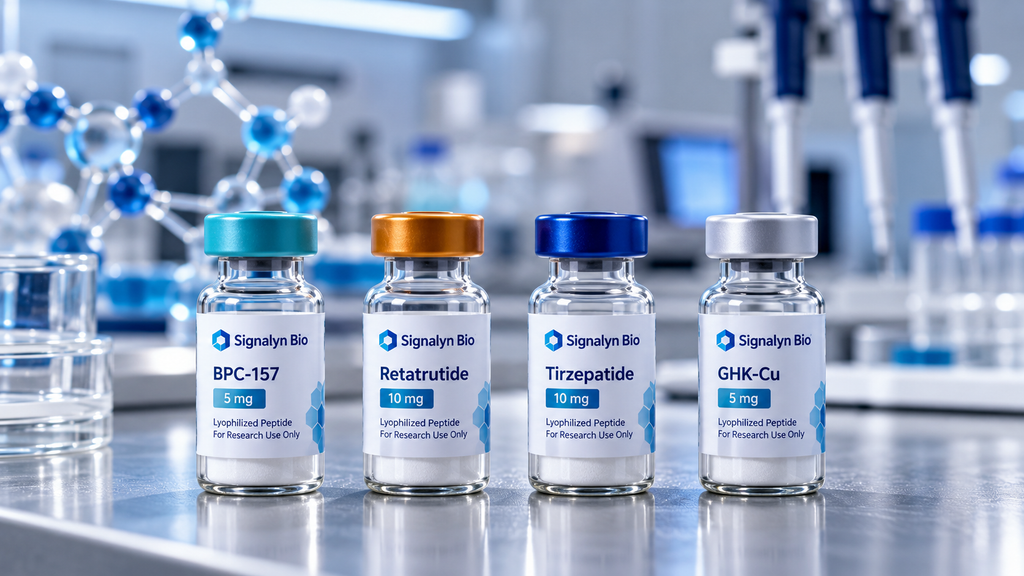
Each Klow ingredient has a genuine — if limited — research record. Here is what the literature actually supports for each, stripped of blend marketing:
1. GHK-Cu (50 mg) — the skin and matrix peptide
GHK-Cu (glycyl-histidyl-lysine + copper) is the best-studied of the four in humans — but almost entirely as a topical agent. Human skin and hair studies used 0.5–3% concentrations over 8–12 weeks. The injectable evidence is animal-only (1–20 mg/kg in mice and rats); no human injection trial exists. Two honesty notes most vendor guides skip: a 2006 randomized trial found no objective benefit over control, and the oft-cited 2002 “landmark study” was a conference abstract, never a full paper. GHK-Cu is not an approved drug anywhere.
Also read: our GHK-Cu Dosage Guide covers the topical concentrations and animal injectable doses in full detail.
2. BPC-157 (10 mg) — the gut and tendon peptide
BPC-157 is a 15-amino-acid peptide derived from a stomach protein, with the deepest animal literature of the group — tendon, ligament, gut, and muscle-injury models in rats, typically dosed at 10 µg/kg to 20 µg/kg. The community’s “200–500 mcg per day” figure is informal extrapolation with no scientific basis, as our dosage guide documents with the math. No human dose exists, and no human efficacy trial has been completed.
Also read: BPC-157 Dosage Guide — every dose figure traced to its source study, including the oral-vs-injectable evidence.
3. TB-500 (10 mg) — the identity problem
TB-500 carries the blend’s biggest quality caveat: the label covers two different molecules — a 7-amino-acid fragment (~889 Da) and full-length synthetic thymosin beta-4 (43 amino acids, ~4963 Da). Human trials exist only for the full-length version, and none led to approval. Verify which molecule a vial actually contains via mass spectrometry on the COA — a step most Klow marketing skips entirely. TB-500 and its derivatives are prohibited by WADA in and out of competition.
Also read: BPC-157 and TB-500: The Wolverine Stack — the evidence-vs-lore breakdown, including the only controlled combination study ever published.
4. KPV (10 mg) — the inflammation modulator
KPV (lysine-proline-valine), a fragment of the anti-inflammatory hormone α-MSH, is the blend’s newest addition and its least-studied member. Preclinical work shows consistent anti-inflammatory signals — NF-κB suppression, reduced TNF-α and IL-6 — in cell cultures and animal colitis models. No human trials exist. Community injectable discussions reference 200–500 mcg/day, which is anecdotal, not evidence-based.
Also read: our KPV Peptide Guide on the melanocortin mechanism and the preclinical literature.
The Honest Problem: No Research on the Blend Itself
Here is the sentence most Klow content never prints: as of October 2026, no published controlled study has tested the four-peptide Klow combination — not in animals, not in cells, not in humans. Every “Klow benefit” list you’ve seen is assembled by taking each peptide’s individual literature and assuming the effects stack. That assumption has a name in pharmacology — synergy — and it requires proof, because combinations frequently don’t add up.
The cautionary tale comes from inside this very blend. Biçer et al. (2026) ran the only controlled study ever published on a BPC-157 + TB-500 combination — 32 rats, Achilles tendon repair, 30 days — and found the combination no better than either peptide alone on any measured endpoint. Two peptides with individually positive animal data, combined, produced nothing extra. Scale that lesson from two peptides to four, and the gap between Klow marketing and Klow evidence becomes clear.
This doesn’t make the blend worthless for research — multi-target hypotheses are legitimate science. It makes unqualified benefit claims dishonest. A credible Klow discussion talks about four separate evidence bases and one untested combination, not about “synergistic recovery.”
Klow Dosage: Why No Standard Protocol Exists
Vendor blogs publish “Klow dosage charts” with confident daily totals. They are anecdotal compilations, not protocols — no dose-response study, human or animal, has ever been run on the blend. But there is a deeper structural reason a Klow protocol can’t exist in the way single-peptide protocols can:
- Fixed ratios can’t be titrated. In an 80 mg vial at 50/10/10/10, every dose contains all four peptides in lockstep. Want more BPC-157 relative to GHK-Cu? Impossible without a second vial. Blend dosing surrenders the single most important tool in any dosing scheme — independent adjustment.
- Four unknowns multiply. Each component’s human dose-response is already unknown (no human trials for BPC-157, TB-500 as sold, KPV, or injectable GHK-Cu). A combination protocol would need to solve four unknowns simultaneously plus their interactions — a study nobody has run.
- Community figures are per-peptide folklore. The 200–500 mcg/day figures attached to BPC-157 and KPV are informal extrapolations discussed in our component guides. Copying them into a blend chart doesn’t make them more valid; it launders anecdote through arithmetic.
For researchers, the practical implication: treat Klow as four parallel single-peptide questions sharing one vial, and consult each component’s guide for what its literature actually supports. Our reconstitution guide covers the math for multi-milligram vials if you’re working with the 80 mg format in the lab.
Klow vs Glow vs Wolverine Stack
The blend-naming landscape is confusing by design. A quick map:
- Wolverine Stack — BPC-157 + TB-500, the original two-peptide recovery combo. The only one of these blends with a published combination study (Biçer 2026, negative result).
- Glow — GHK-Cu + BPC-157 + TB-500, the three-peptide predecessor. Same evidence situation as Klow: components studied separately, combination untested.
- Klow — Glow plus KPV. Four peptides, same untested-combination status, with the added fixed-ratio limitation.
The pattern across all three: marketing got there before evidence. That doesn’t disqualify them as research subjects — it defines the research question.
Side Effects and Safety
Safety assessment for a blend is harder than for a single peptide, because unknowns compound. What can be said honestly:
- No component has human safety data as an injectable. BPC-157, TB-500 (as sold), KPV, and injectable GHK-Cu have never completed human trials. The blend inherits four separate evidence gaps, not one.
- Interaction effects are unstudied. Four bioactive peptides in one preparation means four potential interaction surfaces — immune, metabolic, and otherwise — with zero published data.
- The TB-500 identity issue matters more in a blend. If the vial’s TB-500 component is the 889 Da fragment rather than full-length Tβ4, the blend’s composition differs from what the label implies. Component-level mass-spec verification is the only way to know.
- WADA status transfers. TB-500’s prohibition (S2.3) applies regardless of what it’s blended with — tested athletes should treat Klow as containing a prohibited substance.
How to Evaluate a Klow Blend Supplier
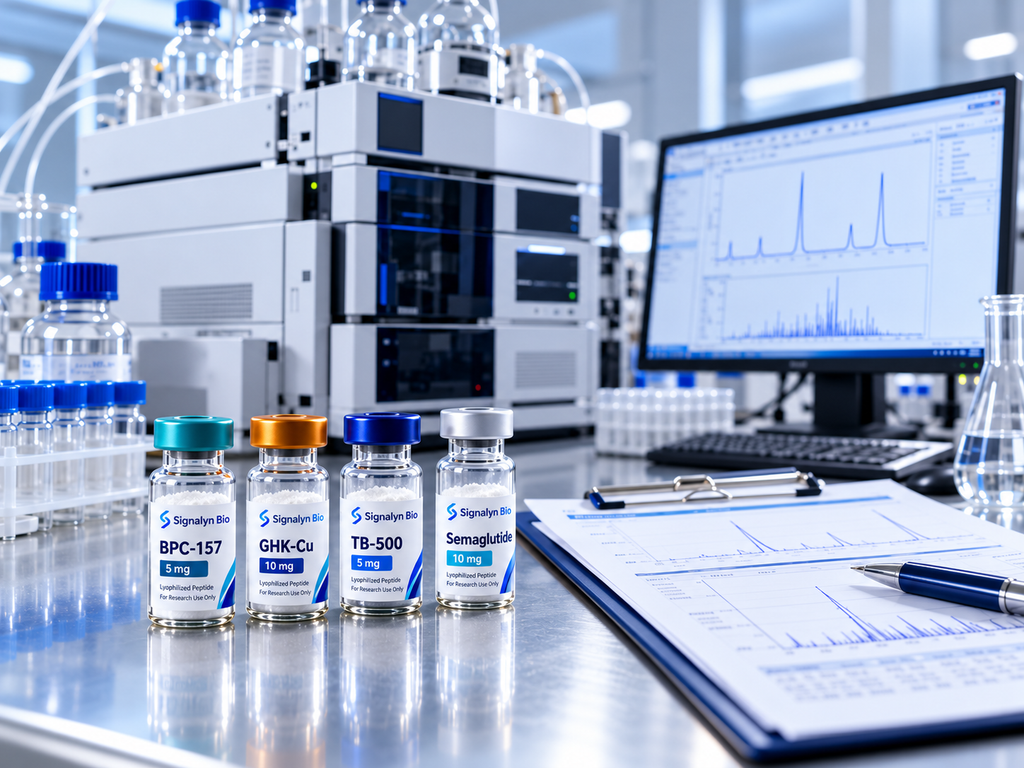
A four-peptide blend is where supplier quality differences become most visible — and most consequential. A single “99% purity” figure on a Klow COA is meaningless: purity of what, exactly? A credible supplier documents the blend the way it was made — four peptides, four identities, four purities:
- Component-level COAs — ask for identity and purity data for each of the four peptides, not one summary number. Four chromatograms, four mass spectra.
- Mass-spec identity per component — this is the only check that catches the TB-500 fragment-vs-full-length problem and confirms the KPV tripeptide is actually present.
- Ratio verification — does the analytical data support the claimed 50/10/10/10 composition, or is one component under-represented?
- Third-party testing covering all four — an independent lab report that verifies the complete blend, not just the easiest component to test.
- Red flags — a single purity percentage with no per-component data, no mass spectra, or a COA that doesn’t mention all four peptides by name.
Also read: how to read a peptide COA — what each section of a certificate actually proves, and what it can’t.
Frequently Asked Questions
What is Klow peptide?
Klow is a vendor-created blend of four research peptides — GHK-Cu (50 mg), BPC-157 (10 mg), TB-500 (10 mg), and KPV (10 mg) — co-lyophilized in a single 80 mg vial. It is not a pharmaceutical product, has no standardized formulation, and the name has no clinical or regulatory meaning.
What are the benefits of the Klow blend?
No benefits have been demonstrated for the blend itself — no published study has tested the four peptides together. Each component has its own preclinical literature (skin and matrix biology for GHK-Cu, tissue-repair models for BPC-157, cell-migration research for TB-500, inflammation models for KPV), but “Klow benefits” as a package are extrapolated, not evidenced.
What is the standard Klow dosage?
There is none. No dose-response study — human or animal — has been run on the Klow blend, so every “Klow protocol” online is anecdotal. A further limitation: the fixed 50/10/10/10 ratio means components cannot be dosed independently. Per-component community discussion ranges are covered in our individual peptide guides, with the caveat that none are evidence-based.
Is Klow safe?
Unknown. None of the four components has completed human trials as an injectable, and interaction effects between them are entirely unstudied. The blend’s safety profile is four separate evidence gaps, not one assessed product. It is sold strictly for laboratory research use.
What is the difference between Klow and Glow?
Glow is the three-peptide predecessor (GHK-Cu + BPC-157 + TB-500). Klow is Glow plus KPV as a fourth component. Both are vendor-created blends with no published combination studies; the same evidence caveats apply to each.
Can the four Klow peptides be bought separately?
Yes — and for research purposes, separate vials have a real advantage: each peptide can be dosed, timed, and analyzed independently, which a fixed-ratio blend doesn’t allow. Blends trade experimental control for convenience.
Researching multi-peptide blends? Browse our third-party tested research peptides — every component verified for identity and purity, with published certificates of analysis.
Advanced research: BPC-157 and TB-500: The Wolverine Stack — the evidence-vs-lore method applied to the original two-peptide combo, including the Biçer 2026 combination study.
Disclaimer: This article is for informational and educational purposes only and does not constitute medical advice. Klow is a vendor-created blend with no published clinical research on the combination itself. Peptides sold on this site are for laboratory research use only and are not intended for human or veterinary use. Always consult a qualified healthcare professional before making decisions about your health.
Leave a Reply