
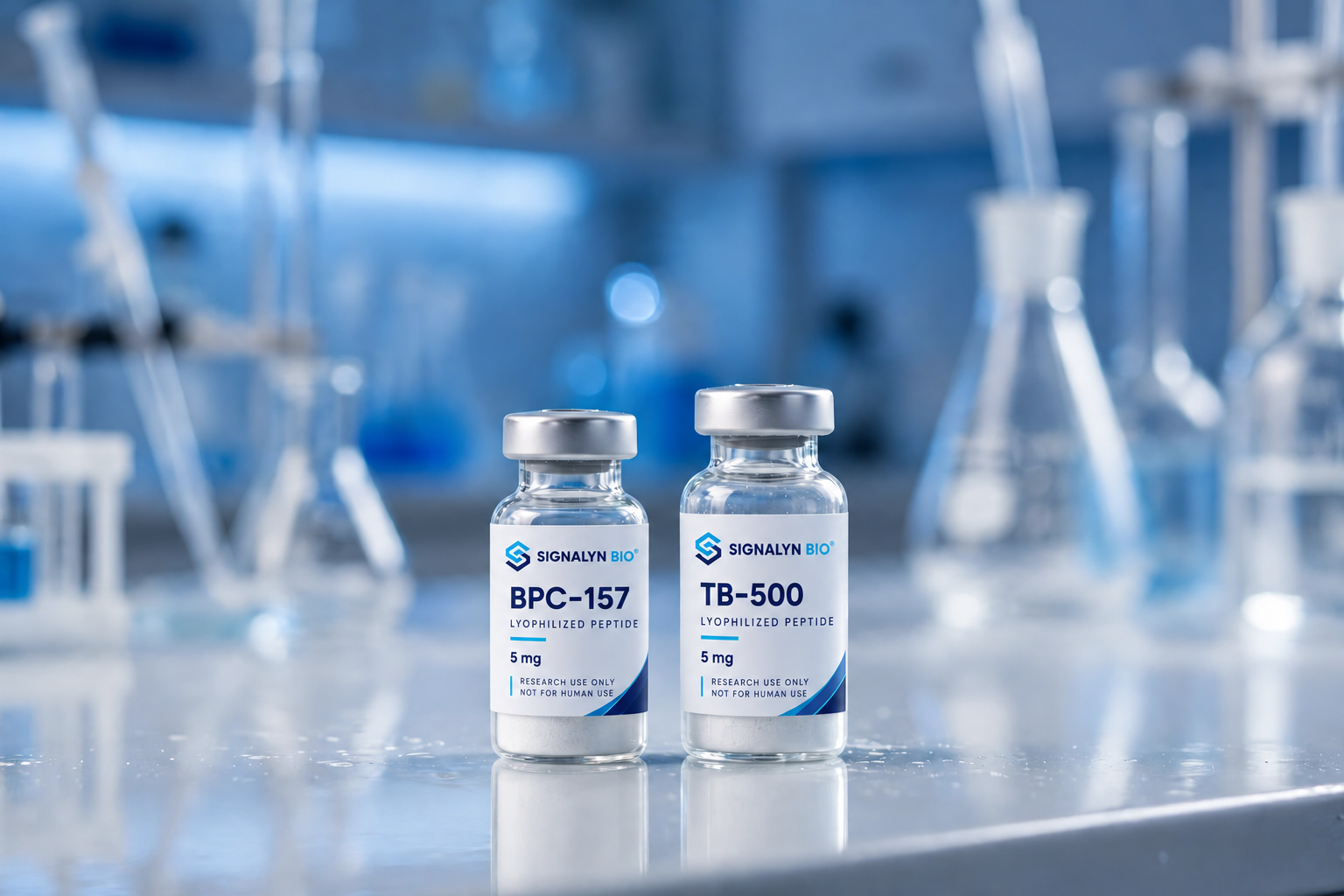
Neither BPC-157 nor TB-500 is FDA-approved, and there is no established human dose for either — alone or combined. The “Wolverine Stack” is a community nickname for pairing the two, built on a theory of complementary mechanisms. In 2026, the first (and still only) controlled combination study was published — and its result was negative: the pair performed no better than either peptide alone. This guide separates what the literature actually shows from what forums claim.
The Short Answer
- “Wolverine Stack” is a nickname, not a protocol. It comes from Marvel’s Wolverine and his rapid healing — the biohacking community’s term, with no clinical origin.
- The synergy story is unproven. The only published head-to-head combination trial (Biçer et al. 2026, 32 rats, 30 days) found no additional benefit of the combination over either peptide alone on any endpoint.
- “TB-500” doesn’t name one molecule. The label is used for two different products: a 7-amino-acid fragment (~889 Da) and full-length synthetic Thymosin Beta-4 (43 amino acids, ~4963 Da). The evidence base for each is completely different.
- All published dosing data is animal data. Every dose figure in this bpc 157 and tb 500 guide is a research protocol in rats or mice — never a recommendation.
What Is TB-500? The Identity Problem First
Before any discussion of bpc 157 tb 500 benefits, the TB-500 label needs decoding, because most guides skip this entirely. “TB-500” is used in the market for two different molecules:
- The 7-peptide fragment — Ac-LKKTETQ, the 17–23 actin-binding region of Thymosin Beta-4; ~889 Da; CAS 885340-08-9. Identified as the active ingredient in a TB-500 product by Esposito et al. 2012 (Drug Testing and Analysis).
- Full-length synthetic Thymosin Beta-4 (Tβ4) — 43 amino acids, N-terminally acetylated; ~4963 Da; CAS 77591-33-4.
How to tell them apart: check the mass spectrometry result. A molecular weight near 4963 means full-length Tβ4; near 889 means the fragment. Their literature bases are entirely different — human clinical trials exist only for full-length Tβ4 (and none led to approval), while the fragment has no published clinical trials at all. Any guide citing “TB-500 clinical trials” without specifying which molecule is conflating two evidence bases.
What Is BPC-157? (Recap)
BPC-157 is a synthetic 15-amino-acid peptide derived from a protective protein in human gastric juice, characterized in the 1990s by the Sikirić group. Its signature property is stability in gastric juice for over 24 hours — exceptional for a peptide. The classic research doses are 10 µg/kg down to 10 pg/kg given daily by intraperitoneal injection in rats. For the full breakdown, see our BPC-157 Dosage Guide, which covers every published protocol study by study.
Why People Pair Them: The Theory
The pairing logic is mechanistic speculation, and it should be labeled as such:
- BPC-157’s studied angle: pro-angiogenic signaling (VEGFR2/NO pathways), tendon and ligament healing in rodent models, unusual oral stability.
- TB-500 / Tβ4’s studied angle: actin monomer binding — regulating the cell cytoskeleton — plus cell migration, angiogenesis, and tissue repair. Tβ4 is expressed in nearly all nucleated mammalian cells, highest in platelets and white blood cells, and was first isolated from bovine thymus by Allan Goldstein in 1966.
- The theory: one peptide supports blood-vessel formation while the other supports cell migration into damaged tissue — therefore, together, better repair. This is a plausible hypothesis with zero mechanistic papers confirming synergy.
The Only Published Combination Study: Biçer et al. 2026
Prior to 2026, the honest statement in every review was: no published study has tested BPC-157 and TB-500 together. Many guides still say this — it is now outdated. Here is what the first one found:
- Design: 32 male Sprague-Dawley rats, Achilles tendon transection with Kessler surgical repair, four groups of 8 (control / BPC-157 / TB-500 / combination), daily intraperitoneal injections for 30 days — BPC-157 10 mcg/kg/day + TB-500 60 mcg/kg/day (Biçer O et al., Joint Diseases and Related Surgery 2026).
- Maximum rupture load (median): control 26.91 N; BPC-157 37.16 N (not significant); TB-500 37.41 N (significant, p=0.041); combination 34.54 N (not significant).
- Histology: only the TB-500 group scored significantly better than control on total Bonar score; both TB-500 and combination groups improved on Movin score.
- Authors’ conclusion: combining the two “provided no additional benefit over either agent alone.” They describe the work as exploratory, calling for dose optimization and longer studies.
The honest reading: the bpc 157 tb 500 dosage pairing was tested, and the combination lost to TB-500 alone. Limitations are real — 8 animals per group, one 4-week timepoint, no blinding of surgery/dosing — but this remains the entire controlled evidence base for the combination. There are no human combination studies.
What Each Peptide Is Studied For: TB-500 Animal Protocols
Representative published protocols (all animal studies — not recommendations):
| Model | Protocol | Source |
|---|---|---|
| Rat Achilles tendon repair | 60 µg/kg/day i.p. × 30 days | Biçer et al. 2026 |
| Rat skin flap survival | 2 and 10 mg/kg/day i.p. × 7 days (dose-dependent improvement) | PMC11094814 |
| Rat traumatic brain injury | 6 and 30 mg/kg i.p. at 6/24/48 h post-injury | PMC3547647 |
| Rat stroke (MCAO) | 2, 12, 18 mg/kg i.p. every 3 days × 4 (12 mg/kg effective; 18 mg/kg not) | PMC4177939 |
| Rat MCL transection | 1 µg Tβ4 in 100 µL fibrin glue, local placement | Regulatory Peptides 2013 |
| Diabetic mouse burns | 5 mg/kg intradermal near wound, 2×/week × 2 weeks | Biochim Biophys Acta 2014 |
Note the dose range spans three orders of magnitude across models (µg/kg to mg/kg) — there is no single “TB-500 dose” in the literature. Human trials of full-length Tβ4 (RGN-259 for dry eye, RGN-352 for cardiac repair, an rhTB4 STEMI trial) all failed to reach approval; a Phase 1 IV study in healthy volunteers (42–1260 mg) reported good tolerance but no efficacy claim. When people search tb500 vs bpc 157, this asymmetry is worth knowing: bpc 157 tb500 peptides are often discussed as a pair, but their evidence bases barely overlap — one is a deep single-lab animal literature, the other includes human trials that went nowhere.
TB-500 vs BPC-157: Key Differences
- Origin: BPC-157 is a synthetic fragment of a gastric protein; Tβ4 is an endogenous protein found throughout the body. BPC-157 has no natural human counterpart at its exact sequence; Tβ4 is already in your blood.
- Oral data: BPC-157 has a published head-to-head oral-vs-injected animal study (Cerovecki et al. 2010) with comparable results; TB-500/Tβ4 has no published oral pharmacokinetic data at all.
- Evidence shape: BPC-157’s literature is deep but narrow (mostly one lab, rodent models); Tβ4’s literature is broader — including human trials — but none of it produced an approved drug.
- Half-life: human IV data for full-length Tβ4 shows 0.5–2 hours; BPC-157’s rat IM half-life is under 30 minutes (different molecules, different studies — not directly comparable).
- Identity clarity: “BPC-157” names one molecule; “TB-500” names two. Always verify molecular weight on the COA.
Also read: our BPC-157 Dosage Guide for the complete protocol-by-protocol breakdown of BPC-157 research dosing.
What About “Wolverine Stack” Protocols Online?
Community-reported protocols (forums, TikTok, wellness clinics) typically describe BPC-157 at a few hundred micrograms daily plus TB-500 at a few milligrams weekly in “loading” then “maintenance” phases, run in 4–6 week cycles. To be explicit: these protocols have no scientific basis. They are not scaled from the animal literature by any standard method, they predate the only combination study, and that study’s result contradicts their premise. Describing them here is documentation of a community phenomenon — not validation.
Regulatory and Competition Status
- Not approved: neither BPC-157 nor TB-500/Tβ4 is approved by the FDA, EMA, or any major regulator for human use.
- WADA prohibited: Thymosin Beta-4 and its derivatives “e.g. TB-500” are on the WADA Prohibited List (S2.3, growth-factor category) — banned in and out of competition. Competitive athletes should know this before touching the topic.
- Compounding note: industry sources reported a July 2026 FDA advisory vote recommending TB-500 for the 503A bulk substances list — a compounding-access question, not a drug approval, and unconfirmed by FDA publication as of this writing.
Frequently Asked Questions
Is the BPC-157 and TB-500 combination proven to work?
No. The only published controlled combination study (Biçer et al. 2026) found no advantage of the combination over either peptide alone in a rat tendon-repair model. There are no human combination studies.
What does “Wolverine Stack” mean?
A community nickname for stacking BPC-157 with TB-500, referencing Marvel’s Wolverine and his rapid healing. It has no clinical origin and predates any published combination research.
Which TB-500 am I buying — the fragment or full-length Tβ4?
Check the mass spectrometry data on the COA: ~889 Da indicates the 7-amino-acid fragment (Ac-LKKTETQ); ~4963 Da indicates full-length synthetic Thymosin Beta-4. Reputable suppliers document which one they sell.
Can BPC-157 and TB-500 be taken together?
There is no approved human regimen for either peptide, alone or combined. The only combination data point is a 30-day rat study with a negative result for added benefit. This is a research question, not an established practice.
What bpc 157 tb 500 dosage did the combination study use?
Biçer et al. 2026 used BPC-157 at 10 mcg/kg/day and TB-500 at 60 mcg/kg/day, given together by daily intraperitoneal injection for 30 days in rats after Achilles tendon repair. The combination showed no advantage over either peptide alone. This is the only published bpc 157 tb 500 dosage protocol ever tested in a controlled study.
Why did the Wolverine Stack become popular?
Gym and biohacking communities coined the name years ago, and short-form video (notably TikTok, where related pages drew millions of views in 2026) amplified it far beyond any evidence. The popularity curve tracks social media, not publications — the first controlled study arrived only in 2026, after the trend was already years old.
Is TB-500 banned in sports?
Yes. Thymosin Beta-4 and its derivatives including TB-500 are on the WADA Prohibited List, banned both in and out of competition.
Researching the bpc 157 and tb 500 combination? Start with correctly identified material. Our BPC-157 and TB-500 collections ship with HPLC and mass spectrometry documentation on every batch — including the molecular-weight verification that tells you exactly which TB-500 you hold — plus third-party COA verification.
Advanced research: TB-500 identity verification — how to read a COA mass spec result and confirm whether your vial holds the 889 Da fragment or the 4963 Da full-length peptide.
Disclaimer: This article is for informational and educational purposes only and does not constitute medical advice. BPC-157 and TB-500 (Thymosin Beta-4) are not approved by any regulatory authority for human use; all doses cited are from published animal studies and are not recommendations. Peptides sold on this site are for laboratory research use only and are not intended for human or veterinary use. Consult a qualified healthcare professional for medical decisions. Thymosin Beta-4 and its derivatives are prohibited by WADA in competitive sports.
Leave a Reply