
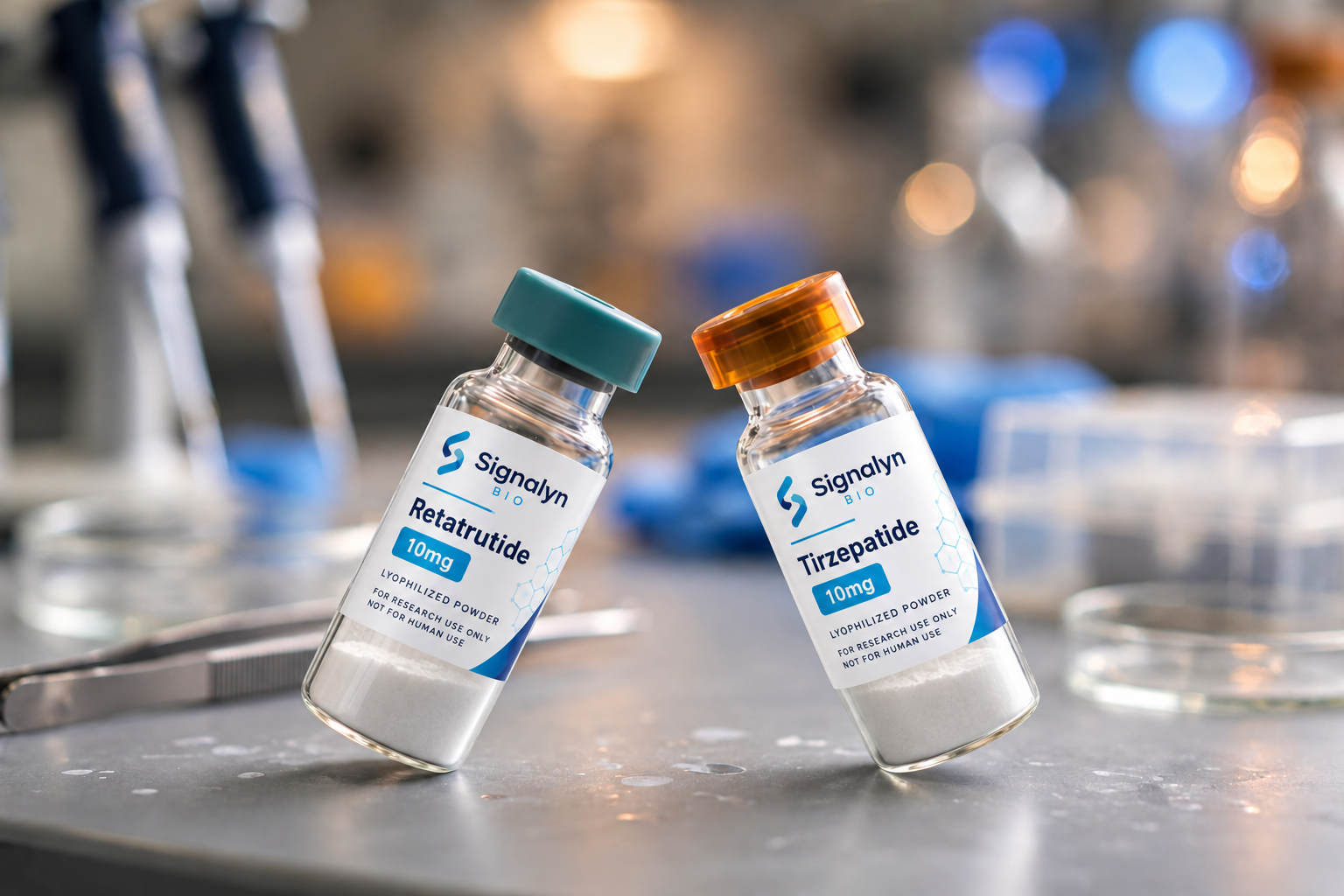
Two drugs from the same company now define the two ends of the metabolic peptide story: tirzepatide, Eli Lilly’s dual agonist sold as Mounjaro and Zepbound, and retatrutide, Lilly’s investigational triple agonist posting the largest weight-loss numbers ever reported in an obesity trial. One is an FDA-approved medicine available at pharmacies today; the other exists only inside clinical trials. This retatrutide vs tirzepatide comparison breaks down the mechanisms, what the trials actually show, where the evidence is solid and where it is not, and which compound fits a research context.
The Short Answer
- Tirzepatide — a dual GIP/GLP-1 receptor agonist, FDA-approved as Mounjaro (type 2 diabetes, 2022) and Zepbound (weight management, 2023; sleep apnea, 2024). In the 72-week SURMOUNT-1 trial, the 15 mg dose averaged 20.9% weight loss vs 3.1% for placebo.
- Retatrutide — a triple agonist adding the glucagon receptor, still investigational. In the 80-week TRIUMPH-1 trial, the 12 mg dose averaged 28.3% weight loss vs 2.2% for placebo (efficacy estimand) — the deepest reduction reported in any registrational obesity trial to date.
- The honest caveat — no head-to-head trial exists. Every number in this article comes from separate trials with different populations, durations, and statistical methods, plus one network meta-analysis that compares the two drugs indirectly. Cross-trial comparisons are directional, not definitive.
Retatrutide vs Tirzepatide at a Glance
| Retatrutide | Tirzepatide | |
|---|---|---|
| Developer | Eli Lilly (LY3437943) | Eli Lilly |
| Mechanism | Triple agonist: GIP + GLP-1 + glucagon | Dual agonist: GIP + GLP-1 |
| Status | Investigational (Phase 3) | FDA-approved |
| Brand names | None yet | Mounjaro (T2D), Zepbound (obesity, OSA) |
| Administration | Once-weekly injection (in trials) | Once-weekly injection |
| Best reported weight loss | 28.3% at 80 weeks, 12 mg (TRIUMPH-1) | 20.9% at 72 weeks, 15 mg (SURMOUNT-1) |
| Weight loss with T2D | 20.8% at 80 weeks, 12 mg (TRIUMPH-2) | 15.7% at 72 weeks, 15 mg (SURMOUNT-2) |
| A1C reduction (T2D) | −1.5 to −1.6% (TRIUMPH-2) | ~−2.1% (SURMOUNT-2) |
| Availability | Clinical trials only | Pharmacies, by prescription |
What Is Retatrutide?
Retatrutide (development code LY3437943) is an investigational once-weekly injectable developed by Eli Lilly. It is the first triple hormone receptor agonist to reach Phase 3 testing, activating the GIP, GLP-1, and glucagon receptors simultaneously. As of October 2026, retatrutide is not FDA-approved and has no brand name; Lilly has guided for a biologics license application (BLA) submission in the first quarter of 2027.
The evidence base is the TRIUMPH Phase 3 program: four large trials covering obesity (TRIUMPH-1), obesity with type 2 diabetes (TRIUMPH-2), severe obesity with cardiovascular risk (TRIUMPH-3), and obesity with knee osteoarthritis (TRIUMPH-4). Topline results have been released for all four; the full TRIUMPH-1 and TRIUMPH-2 papers were published in September 2026.
Also read: our Retatrutide Dosing Schedule guide breaks down the exact titration protocol the trials used, week by week.
What Is Tirzepatide?
Tirzepatide is Eli Lilly’s dual GIP/GLP-1 receptor agonist — the same company’s earlier incretin drug, and the direct predecessor against which retatrutide is now measured. Unlike retatrutide, tirzepatide is a fully approved medicine with three FDA indications:
- Mounjaro — approved May 2022 for type 2 diabetes.
- Zepbound — approved November 2023 for chronic weight management in adults with obesity, or overweight with a weight-related condition.
- Zepbound — approved December 2024 for moderate-to-severe obstructive sleep apnea in adults with obesity, the first drug approval of its kind for the condition.
The evidence base is the SURMOUNT Phase 3 program, led by SURMOUNT-1 (obesity without diabetes) and SURMOUNT-2 (obesity with type 2 diabetes), both 72-week randomized trials published in the New England Journal of Medicine and The Lancet respectively. With several years of real-world prescribing behind it, tirzepatide has the mature, peer-reviewed safety record that an investigational drug cannot yet match.
The Mechanism Difference: What the Third Receptor Adds

Both drugs work through the incretin system, but they pull different levers:
- GLP-1 receptor activation (both drugs) — suppresses appetite, slows gastric emptying, and enhances glucose-dependent insulin secretion. This is the backbone of every modern metabolic peptide.
- GIP receptor activation (both drugs) — complements GLP-1 on appetite and glycemic control; tirzepatide’s dual action was itself a step beyond single-target GLP-1 drugs like semaglutide.
- Glucagon receptor activation (retatrutide only) — the differentiator. Glucagon signaling increases energy expenditure and hepatic glucose output. In theory, adding it means retatrutide attacks weight from two directions at once: eating less (GLP-1/GIP) and burning more (glucagon).
That two-directional hypothesis is the leading explanation for why retatrutide’s trial weight-loss figures exceed tirzepatide’s. But it comes with a trade-off researchers should note: glucagon raises blood glucose, so the net glycemic effect of a triple agonist is a balance the trials had to prove, not assume. The A1C data below shows how that balance played out.
Weight-Loss Results: What the Trials Actually Show
Read this before comparing any numbers: TRIUMPH and SURMOUNT enrolled different populations, ran for different durations (80 vs 72 weeks), and reported different statistical estimands. The figures below are the best available evidence — not a head-to-head result.
Obesity without diabetes
- Retatrutide (TRIUMPH-1) — 2,339 adults, 80 weeks: the 12 mg dose averaged 28.3% weight loss (efficacy estimand) and 25.0% (treatment-regimen estimand), vs 2.2% for placebo.
- Tirzepatide (SURMOUNT-1) — 2,539 adults, 72 weeks: the 15 mg dose averaged 20.9% weight loss, vs 3.1% for placebo. Lower doses: 10 mg 19.5%, 5 mg 15.0%.
Obesity with type 2 diabetes
- Retatrutide (TRIUMPH-2) — 1,152 adults, 80 weeks: the 12 mg dose averaged 20.8% weight loss.
- Tirzepatide (SURMOUNT-2) — 938 adults, 72 weeks: the 15 mg dose averaged 15.7% weight loss, vs 3.3% for placebo.
The pattern is consistent: in both populations, retatrutide’s reported mean reduction runs roughly 5–8 percentage points higher than tirzepatide’s. But the only analysis that puts both drugs in one statistical model is a network meta-analysis (Salhab et al., presented at ENDO 2025, Journal of the Endocrine Society), which pooled 12 trials indirectly: retatrutide showed a mean difference of −16.34 kg (−23.77%) vs placebo, compared with −11.82 kg (−16.79%) for tirzepatide. The authors’ own conclusion is the responsible one: retatrutide shows superior weight reduction in indirect comparison, with a higher frequency of adverse events — and direct head-to-head trials are still needed.
Blood Sugar Effects
Weight loss gets the headlines, but both drugs were also measured on glycemic control in participants with type 2 diabetes:
- Retatrutide (TRIUMPH-2) — A1C fell by 1.5 to 1.6 percentage points at the 12 mg dose. A solid result, though notably smaller than its weight-loss effect — consistent with the glucagon component partially offsetting the incretin-driven glucose lowering.
- Tirzepatide (SURMOUNT-2) — A1C fell by about 2.1 percentage points at both the 10 and 15 mg doses, with roughly half of participants reaching normal A1C levels below 5.7%.
This is the one efficacy domain where the approved drug currently leads: tirzepatide’s glycemic data is deeper, with years of real-world confirmation behind the trial figures.
Side Effects Compared
Both drugs share the familiar incretin side-effect profile — overwhelmingly gastrointestinal:
- Tirzepatide — nausea, diarrhea, vomiting, and constipation, mostly mild-to-moderate and concentrated during dose escalation. Its safety profile is well-characterized after years of widespread prescribing; the FDA label carries warnings for pancreatitis and gallbladder disease, as with the drug class.
- Retatrutide — a similar GI profile (transient nausea, diarrhea, constipation), clearly dose-dependent. Phase 2 data showed that starting at 2 mg produced meaningfully fewer GI events than starting at 4 mg — one reason the Phase 3 program standardized the 2 mg start.
The network meta-analysis quantified the gap: adverse events were more frequent with retatrutide (relative risk 4.10 vs placebo) than with tirzepatide (2.78). The honest reading is that retatrutide’s higher efficacy ceiling appears to come with a higher side-effect burden — a trade-off that only long-term data can fully characterize, and long-term data is exactly what an investigational drug lacks.
Approval Status and Availability: The Decisive Difference
Strip away the trial numbers and one fact dominates this comparison: tirzepatide is a medicine and retatrutide is not — yet. Tirzepatide can be prescribed today and dispensed at any pharmacy, with insurance coverage for eligible patients. Retatrutide cannot be prescribed, has no brand name, no price, and no pharmacy distribution; it exists only within clinical trials and the research-supply chain. Under federal law, retatrutide cannot be compounded as an approved-drug alternative the way GLP-1 drugs were during shortages.
That status gap cuts both ways for researchers. Tirzepatide offers a stable, well-documented reference compound with a known safety record — the right comparator for most metabolic research designs. Retatrutide offers the higher observed efficacy ceiling and the broader triple-receptor mechanism — the more interesting molecule for next-generation research questions. They are not substitutes for each other; they answer different questions.
Also read: Retatrutide vs Ozempic — how the triple agonist compares against the single-target GLP-1 drug that started the modern weight-loss era.
Dosing and Administration

Both compounds are once-weekly subcutaneous injections — that is where the similarity ends, and nothing in this section is a recommendation:
- Retatrutide (trials only) — the Phase 3 program used a standardized titration: 2 mg starting dose, increasing one step every 4 weeks (2 → 4 → 6 → 9 → 12 mg) toward maintenance doses of 4, 9, or 12 mg. Full week-by-week detail is in our Retatrutide Dosing Schedule guide.
- Tirzepatide (prescription) — as an approved drug, its dosing is defined by the FDA label: treatment starts at 2.5 mg weekly and steps up by 2.5 mg every 4 weeks to a maximum of 15 mg, adjusted by the prescribing physician. Dosing decisions for approved medicines belong to clinicians, not to comparison articles.
Which One Fits Your Research?
For laboratory and analytical research contexts, the choice depends on the question being asked:
- Choose tirzepatide as a reference — when the study needs an approved, fully characterized comparator with established analytical standards, known impurity profiles, and years of documented clinical behavior.
- Choose retatrutide as a research target — when the question concerns next-generation multi-agonist pharmacology: glucagon-receptor contribution to energy expenditure, triple-agonist structure-activity relationships, or analytical method development for an investigational sequence.
- Choose both — comparative analytical studies (identity, purity, stability profiling across the two molecules) are among the most informative designs, since the compounds share a developer and a therapeutic area but differ by exactly one receptor target.
Also read: Retatrutide Cost: 2026 Buyer’s Guide — what drives pricing in the research-peptide market and how to vet a supplier before requesting a quote.
Frequently Asked Questions
Is retatrutide better than tirzepatide for weight loss?
In reported trial averages, yes — retatrutide’s 12 mg dose averaged 28.3% weight loss at 80 weeks (TRIUMPH-1) versus 20.9% for tirzepatide’s 15 mg at 72 weeks (SURMOUNT-1), and a network meta-analysis found the same direction of effect. But these are separate trials, not a head-to-head comparison, and retatrutide also showed a higher frequency of adverse events. “Better” depends on whether you weight peak efficacy or established safety more heavily.
Has retatrutide been directly compared with tirzepatide in a trial?
No. As of October 2026, no head-to-head randomized trial of retatrutide versus tirzepatide has been completed or announced. The closest available evidence is a 2025 network meta-analysis (Salhab et al., Journal of the Endocrine Society) that compared the two drugs indirectly across 12 trials — a legitimate statistical method, but not a substitute for direct comparison.
Will retatrutide replace Zepbound?
Not in the near term. Zepbound (tirzepatide) is FDA-approved, widely prescribed, and covered by many insurance plans today. Retatrutide has not completed Phase 3, has no FDA submission yet (a BLA is guided for Q1 2027), and would need regulatory review before any approval — a process measured in years, not months. Even after a potential approval, the two drugs would likely coexist for different patient profiles.
What is the mechanism difference between retatrutide and tirzepatide?
Tirzepatide activates two receptors: GIP and GLP-1. Retatrutide activates those same two plus the glucagon receptor — three targets instead of two. The added glucagon activity is thought to increase energy expenditure on top of the appetite suppression from the incretin pathways, which is the leading explanation for retatrutide’s larger reported weight-loss figures.
Is retatrutide available now?
No. Retatrutide is an investigational drug available only through clinical trials. It has no brand name, no FDA approval, and no pharmacy distribution. Any product sold online under the retatrutide name is a research chemical, not the clinical-trial drug — a distinction our Retatrutide Cost Guide covers in detail.
Can you switch from tirzepatide to retatrutide?
There is no clinical data on switching between these drugs, and retatrutide is not available outside clinical trials — so the question has no evidence-based answer today. Anyone considering changes to a prescribed metabolic medication should discuss it with their prescribing clinician, not with a comparison article.
Researching next-generation metabolic peptides? Browse our third-party tested retatrutide research peptides — every batch verified for purity and identity, with published certificates of analysis.
Advanced research: Retatrutide Dosing Schedule: What Clinical Trials Used — the official Phase 3 titration protocol, week by week, and how it differs from the Phase 2 design.
Disclaimer: This article is for informational and educational purposes only and does not constitute medical advice. Retatrutide is an investigational compound that has not been approved by the FDA; tirzepatide (Mounjaro/Zepbound) is a prescription medicine. Peptides sold on this site are for laboratory research use only and are not intended for human or veterinary use. Always consult a qualified healthcare professional before making decisions about your health.
Leave a Reply