
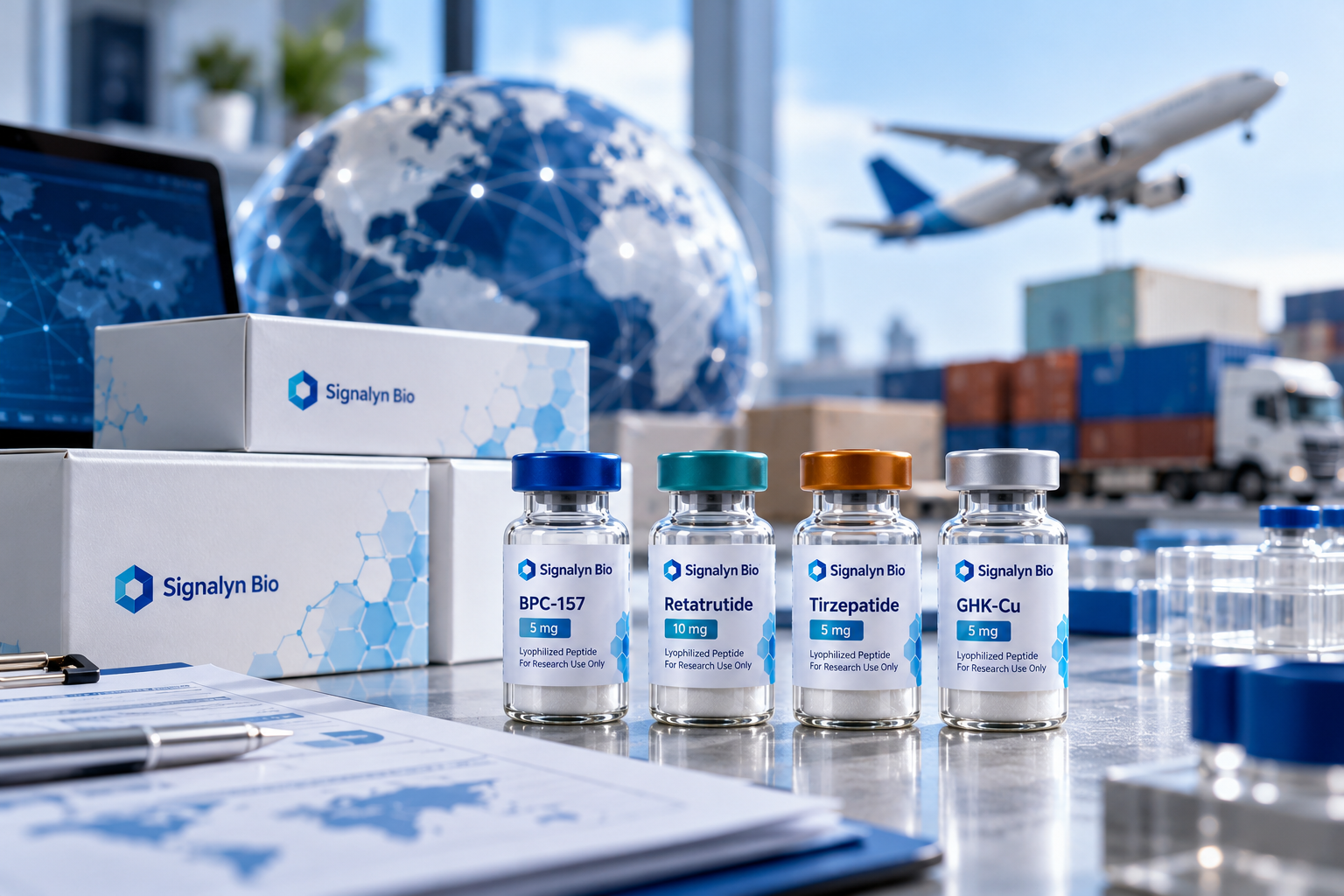
A large share of the world’s custom peptides are synthesized in China — the synthesis capacity, cost structure, and turnaround are real advantages. So are the risks: quality varies enormously between suppliers, and a buyer who can’t tell a manufacturer from a trading company is flying blind. This guide is a practical vetting framework for sourcing peptides from China: what to verify, what to ask for in writing, and which red flags end the conversation.
The Short Answer
- Why China — deep solid-phase synthesis capacity, competitive cost structure, and fast turnaround make Chinese suppliers a rational first look for custom and bulk peptides.
- The risk — the market mixes genuine manufacturers with traders reselling other labs’ material, and documentation quality ranges from rigorous to fictional. The supplier matters more than the country.
- The rule — verify manufacturing capability, audit the COA like a document (not a certificate), and require third-party testing before committing to volume. Everything below is how.
Why Buyers Source Peptides from China
The reasons are structural, not mysterious:
- Synthesis capacity. China hosts some of the highest-volume solid-phase peptide synthesis (SPPS) operations in the world, from research scale to multi-kilogram GMP production. Capacity is rarely the constraint.
- Cost structure. Labor, facility, and reagent costs run lower than in the US or EU, which shows up directly in custom-synthesis quotes — especially for long or difficult sequences where synthesis labor dominates.
- Turnaround. High-throughput labs quote shorter lead times for standard work, because the equipment and staffing are already scaled for volume.
- Full-chain services. Many Chinese suppliers bundle synthesis, purification, lyophilization, and analytical documentation in one project — fewer handoffs than assembling the chain yourself.
None of this guarantees quality. It explains why the sourcing conversation starts in China — and why the vetting conversation matters more than the sourcing one.
The Real Risks (Stated Plainly)
Buyers who get burned in China usually get burned the same few ways:
- Traders posing as manufacturers. A trading company takes your order, outsources synthesis to an unknown lab, and marks it up. You lose visibility into the actual production — and the trader can’t answer technical questions because they never made anything.
- Paper COAs. A “99% purity” certificate with no chromatogram, no mass spectrum, and no batch traceability is a claim, not evidence. This is the single most common quality failure in the market.
- Batch-to-batch drift. The sample was excellent; production batch three is not. Without batch-level documentation tied to batch identifiers, you’ll never prove what changed.
- Communication gaps. Timezone delays are manageable; evasive answers are not. A supplier that can’t explain its own analytical methods in writing will not get clearer after you pay.
- IP and confidentiality exposure. Your novel sequence is your asset. Sharing it with an unverified counterparty — before any confidentiality terms exist — is an avoidable risk.
- Import and compliance friction. Peptides for research use still cross borders as regulated goods. Confirm the shipping terms, documentation, and your own jurisdiction’s import requirements before ordering, not after a customs hold.
How to Vet a Chinese Peptide Supplier: 8 Checks
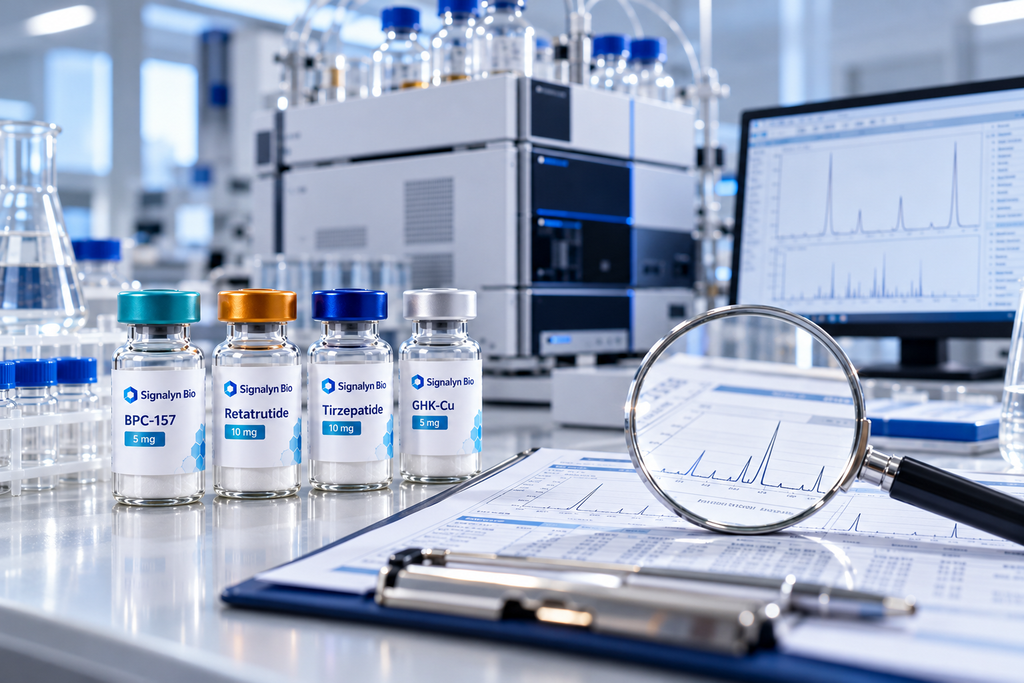
Run every prospective supplier through these checks, in order. A failure at any step is a reason to walk away — there are enough suppliers that you never need to rationalize a bad one.
1. Verify it’s a manufacturer, not a trader
Ask directly: do you synthesize in-house, and can you describe the facility? Then test the answer — ask a technical question only a manufacturer could answer (resin type for a given sequence, cleavage cocktail, purification gradient approach). Traders deflect; manufacturers answer. A supplier that won’t discuss its own production process doesn’t have one.
2. Confirm in-house HPLC and mass spectrometry
Every credible peptide manufacturer runs analytical HPLC and mass spectrometry in-house — purity without identity is half a result, and identity without purity is the other half. “We send everything to a third-party lab” is not disqualifying on its own, but it should make you ask who, how often, and whether you can see unedited reports.
3. Audit the COA like a document, not a certificate
Request a sample COA before ordering — for a real past batch, not a template. Check that it ties together peptide identity, batch number, analytical method, purity result with an actual chromatogram, and mass confirmation with a spectrum. If the “COA” is a one-page summary with a single percentage and no raw data attached, treat the supplier’s quality claims as unverified.
Also read: how to read a peptide COA — a section-by-section breakdown of what each part proves and what it can’t.
4. Require third-party testing support
The strongest trust signal in the industry is independent verification: a sample analyzed by an unaffiliated laboratory, with results you can check yourself. Ask whether the supplier supports third-party testing of your order, and whether they can share verifiable past reports (for example, Janoshik task numbers you can look up). A supplier that resists independent verification is telling you something.
Also read: third-party peptide testing — how independent verification works and what a verifiable report looks like.
5. Start with samples, never with volume
Order a small evaluation batch first and have it tested independently before committing to production quantities. The cost of one verified sample is trivial next to the cost of a bad bulk order. Structure the relationship so that volume is earned, not assumed.
6. Read the MOQ and lead time for realism
Minimum order quantities and lead times are diagnostic. A supplier quoting days for a long, complex, high-purity synthesis is either cutting corners or quoting fiction — real SPPS timelines scale with sequence difficulty. Conversely, get the MOQ, lead time, and what’s included in writing before transferring funds; verbal quotes evaporate.
7. Settle contracts, IP, and confidentiality early
Before sharing novel sequences: confidentiality terms in writing. Before paying: clear terms on specifications, acceptance criteria (what purity, verified how), remake policy for out-of-spec batches, and payment schedule. Professional suppliers expect this paperwork; resistance to it is itself a signal.
8. Treat communication quality as data
How a supplier handles your specification questions before production predicts how they’ll handle problems after it. Precise, technical, documented answers at the quoting stage are a green flag. Vague reassurances, pressure to order quickly, or answers that change between emails are not.
Red Flags That End the Conversation
- A purity percentage with no chromatogram or mass spectrum attached.
- A quote issued without asking for your sequence or specifications.
- Turnaround promises that defy the chemistry (complex synthesis, “next week”).
- No sample COA available — or a COA that’s clearly a template with no real batch data.
- Resistance to third-party testing of your order.
- Payment demanded in full, upfront, with no acceptance criteria in writing.
- The company can’t explain where synthesis actually happens.
Any one of these is sufficient reason to get a second quote. Two or more, and you’re not vetting a supplier — you’re documenting a risk.
Reading a Quote: Price vs Quality

Chinese suppliers’ quotes vary widely for the same nominal product. The variance usually isn’t mysterious — it’s scope. Compare line items, not totals:
- Synthesis and purification — what’s the target purity, and what purification method gets there?
- Analytical package — HPLC and MS included? Full chromatograms and spectra, or a summary number?
- Documentation — batch COA with traceability, or a generic certificate?
- Third-party testing — available, at what cost, through which lab?
- Terms — MOQ, lead time, remake policy, payment schedule.
A lower quote that omits independent testing and provides only a summary COA is not the same product as a higher quote with full analytical records. The cheapest compliant option is found by comparing identical scopes — never by assuming two quotes describe the same thing.
Also read: Custom Peptide Synthesis Guide — how custom projects are priced and what each line item actually covers.
Frequently Asked Questions
Is it safe to buy peptides from China?
It depends entirely on the supplier, not the country. China hosts world-class peptide manufacturers — and trading companies with no lab at all. Safety (in the business sense: getting what you ordered, documented) comes from vetting: verified manufacturing, audited COAs, and third-party testing. An unvetted supplier anywhere is unsafe; a vetted one in China is a rational choice.
How do I verify a Chinese peptide supplier’s COA?
Ask for a sample COA from a real past batch before ordering. Check that peptide identity, batch number, analytical method, purity (with chromatogram), and mass confirmation (with spectrum) are all present and mutually consistent. Then verify independently: have your first order tested by an unaffiliated lab and compare. Our COA reading guide walks through each section.
Should I buy from a manufacturer or a trader?
A manufacturer, whenever possible. Direct manufacturing gives you visibility into production, technical answers from the people who ran the synthesis, and batch traceability. A trader adds a markup and a layer of opacity; if you must use one, verify which lab actually produces the material and insist on the same documentation standards.
What MOQ should I expect?
There is no standard — MOQs vary by supplier, peptide complexity, and production scale. What matters is that the MOQ, lead time, specifications, and acceptance criteria are all confirmed in writing before payment. Vague terms at the quoting stage predict vague accountability later.
Do Chinese peptide suppliers offer third-party testing?
The credible ones do — or at minimum, they don’t obstruct it. Ask whether the supplier supports independent testing of your order and whether they can share verifiable past reports. Support for third-party verification is one of the fastest ways to separate manufacturers with nothing to hide from those with something to.
How do I check if a Chinese peptide company is legitimate?
Start with the basics: a verifiable business registration, a real facility address (not a virtual office), and a website that names its analytical equipment rather than hiding behind stock photos. Then move to the technical checks that actually matter — in-house HPLC and MS, sample COAs from real batches, and willingness to support third-party testing. A legitimate manufacturer answers technical questions precisely and in writing; everything else is secondary evidence. Run the full 8-check framework in this guide before any payment.
What about shipping and customs?
Confirm the shipping terms (Incoterms), carrier, documentation provided, and typical transit arrangements in writing before ordering. Also check your own jurisdiction’s import requirements for research-use peptides — a shipment held at customs is a planning failure, not bad luck. Professional suppliers handle export documentation routinely; ask what they provide.
Sourcing a custom peptide project? Explore our custom peptide synthesis services — in-house HPLC and mass spectrometry, batch-level COAs, and third-party testing support, with every project quoted against your specifications. Also see our Peptide Buyer’s Guide for the general supplier-evaluation checklist.
Advanced research: Custom Peptide Synthesis: How It Works, Pricing & Choosing a Manufacturer — the full workflow from sequence to documented batch.
Disclaimer: This article is for informational and educational purposes only. It describes a supplier-vetting methodology and does not rank, review, or endorse any supplier. Peptides discussed on this site are for laboratory research use only and are not intended for human or veterinary use. Import requirements vary by jurisdiction — verify compliance for your location before ordering.
Leave a Reply