
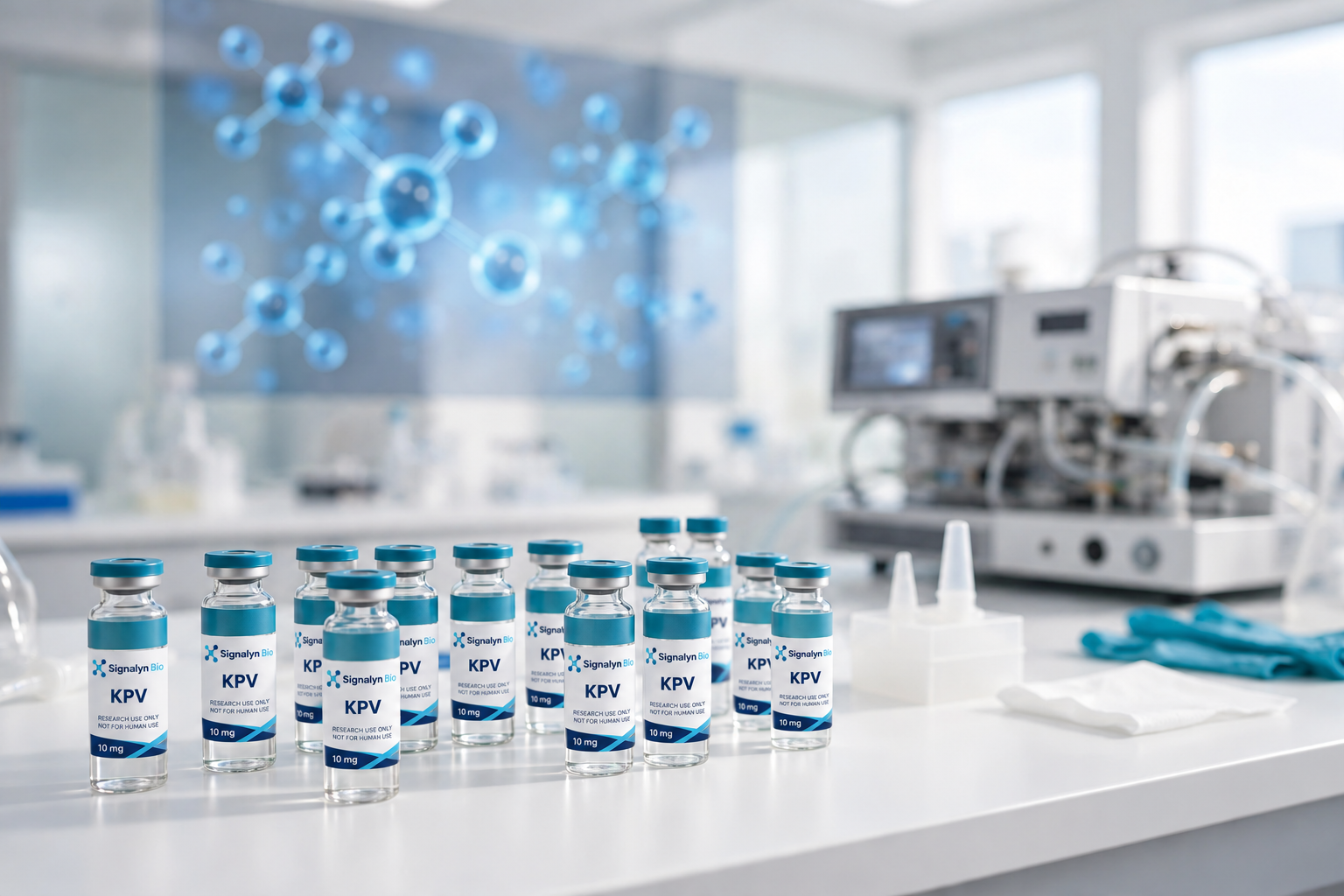
KPV is a three-amino-acid peptide — a fragment of the body’s own anti-inflammatory hormone α-MSH — that researchers study for its potent inflammation-calming effects, especially in the gut and skin. Early preclinical research suggests it suppresses inflammatory signaling without the pigmentary side effects of the full hormone. This guide covers what KPV is, how it may work, the dosage protocols discussed in research, how it compares to BPC-157, and what the safety data actually shows.
What Is KPV?
KPV (Lys-Pro-Val) is a tripeptide — just three amino acids long — corresponding to the last three amino acids (positions 11–13) of alpha-melanocyte-stimulating hormone (α-MSH), one of the body’s own anti-inflammatory signaling molecules.
Researchers found that this tiny fragment appears to retain much of α-MSH’s anti-inflammatory activity — but without the skin-darkening (pigmentary) effects of the full hormone. That separation of effects is what makes KPV interesting as a research compound.
Its small size also gives it useful properties researchers are still exploring, including easier tissue penetration — and it’s stable enough to be studied in injectable, nasal, and topical forms.
Key facts about KPV
- Structure — tripeptide (Lys-Pro-Val), C-terminal fragment of α-MSH
- Research focus — anti-inflammatory and immunomodulatory effects
- Studied areas — gut inflammation, skin inflammation and wound healing, lung and joint inflammation
- Status — research compound only; not FDA-approved; no completed human clinical trials
How KPV Works for Inflammation
Inflammation spirals out of control when immune cells release pro-inflammatory cytokines — TNF-α, IL-1β, IL-6 — that recruit more immune cells in a feedback loop. Helpful in acute injury; destructive when it doesn’t shut off. Preclinical research suggests KPV intervenes in that loop through the melanocortin system — the MC1R, MC3R, and MC4R receptors that α-MSH itself uses:
- NF-κB suppression — NF-κB is the master transcription factor that switches on pro-inflammatory cytokine production. Preclinical research suggests KPV can dampen this pathway, turning down the inflammatory response at its source.
- Lower cytokine release — in cell and animal models, KPV has been associated with reduced TNF-α, IL-1β, and IL-6 — the same cytokines implicated in inflammatory bowel conditions, arthritis, and chronic skin inflammation.
- Immune modulation, not suppression — rather than shutting down the immune system like corticosteroids, KPV appears to calm excessive inflammatory signaling while leaving normal immune function intact, at least in preclinical models. That distinction matters, because broad immunosuppression carries infection risk.
- Gut barrier support — some of the most compelling early research involves the intestinal lining. In animal models of colitis, KPV has been studied for reducing mucosal inflammation and supporting the integrity of the gut barrier — the single-cell layer that keeps gut contents from leaking into the bloodstream.
One emphasis: all of this is preclinical. No published human trials have established KPV’s efficacy, optimal dosing, or long-term safety. What exists is a consistent signal across multiple animal and cell models pointing the same anti-inflammatory direction.
KPV Benefits: Where the Research Points
- Gut inflammation — the most developed area of KPV research. In rodent models of experimentally induced colitis, KPV administration has been associated with reduced inflammatory markers and improved tissue outcomes. The gut is rich in melanocortin receptors, giving the peptide a plausible direct target — and one reason KPV comes up alongside BPC-157 in gut-healing discussions.
- Skin inflammation and wound healing — KPV’s small size makes it a candidate for topical research, and preclinical studies have explored its effects on inflammatory skin responses and the wound-healing cascade. Because it lacks the melanotropic activity of full-length α-MSH, skin research proceeds without the tanning effect that complicates related compounds.
- Lung, joint, and systemic inflammation — since KPV’s mechanism (NF-κB suppression, cytokine reduction) isn’t tissue-specific, preclinical research has also explored airway and joint inflammation models. The appeal is broad inflammation modulation without the side-effect burden of steroids or NSAIDs — still a hypothesis, not an established application.
The honest bottom line: multiple preclinical models, same anti-inflammatory direction, no human data yet. KPV is best understood as a promising research compound with a coherent mechanism — not a proven therapy.
KPV Dosage: Protocols Discussed in Research
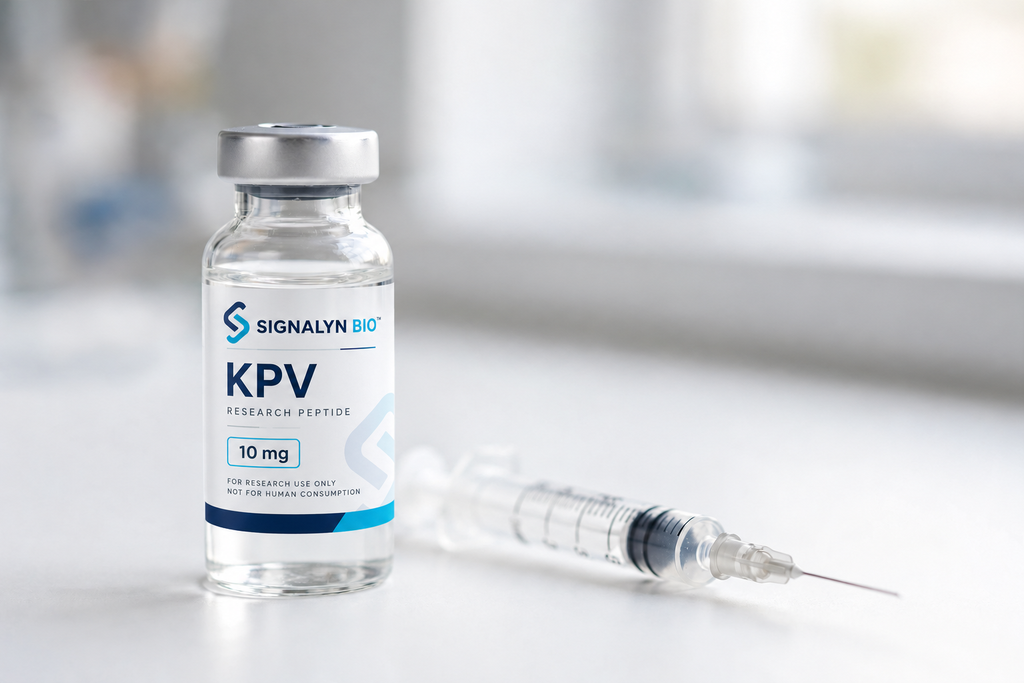
Important: There is no established human dose for KPV. It has not been evaluated in human clinical trials, and nothing in this section is a recommendation. What follows summarizes dosage ranges from preclinical literature and community research discussions, for informational purposes only.
- Injectable (subcutaneous) — the most commonly referenced protocol centers on 200–500 mcg per day, once daily or split into two doses. KPV typically ships as lyophilized powder in 10 mg vials, reconstituted with bacteriostatic water — the standard research-peptide format.
- Cycles — community discussions describe 4–8 week cycles followed by a break, though no clinical basis exists for any specific cycle length. Any “protocol” you find online is anecdotal, not evidence-based.
- Nasal spray — discussed in a similar microgram range to injectable protocols; some researchers favor the non-invasive delivery. Nasal bioavailability is not well characterized, so actual systemic exposure is unknown.
- Topical (cream/serum) — appears mainly in skin-focused research; dosing is described by product concentration rather than daily micrograms, and is the least standardized of all.
KPV dosage summary
| Form | Commonly discussed range | Notes |
|---|---|---|
| Injectable (subcutaneous) | 200–500 mcg/day | Most common format; 10 mg vials typical |
| Nasal spray | Similar mcg range | Bioavailability not well characterized |
| Topical | Varies by formulation | Concentration-based; least standardized |
Also read: How to Reconstitute Peptides: The Complete Step-by-Step Guide — BAC water ratios, dosage math, and storage timelines for any lyophilized peptide, including KPV.
KPV vs BPC-157: Which Is Better for Inflammation?
One of the most common comparison searches in the healing-peptide space — and a fair question, since both are researched for gut and tissue inflammation but work very differently.
| KPV | BPC-157 | |
|---|---|---|
| Origin | α-MSH fragment (tripeptide) | Body Protection Compound (15 amino acids), from a stomach protein |
| Primary mechanism | Melanocortin receptor modulation; NF-κB and cytokine suppression | Angiogenesis, growth factor modulation, gut-brain axis effects |
| Research focus | Anti-inflammatory signaling | Tissue repair, tendon/ligament healing, gut lining |
| Gut research | Colitis models; mucosal inflammation | Extensive gut models; broader tissue-repair evidence |
| Evidence base | Preclinical only; smaller literature | Preclinical; much larger body of animal research |
| Common forms | Injectable, nasal, topical | Injectable, oral capsules |
| Human trials | None published | None completed for most indications |
How to think about the comparison
- For anti-inflammatory signaling research — KPV’s mechanism targets the inflammatory cascade itself (cytokine suppression via melanocortin pathways), making it the more directly targeted compound.
- For tissue repair and injury recovery — BPC-157 has the deeper evidence base, particularly for tendons, ligaments, and the gut lining.
- Not mutually exclusive — some researchers study anti-inflammatory and pro-repair compounds as complementary, since calming inflammation and promoting tissue repair are different (though related) jobs.
If the research interest is inflammatory-bowel-type models, KPV’s colitis-focused preclinical literature makes it worth knowing about. For musculoskeletal injury, BPC-157 (often discussed alongside TB-500) has more published animal research behind it.
KPV Side Effects and Safety
One reason KPV attracts research interest is its apparently mild safety signal in preclinical work — but “mild in animal studies” is a long way from “proven safe in humans.”
- Preclinical tolerance — in animal studies, KPV has been described as well-tolerated, with no significant toxicity signals at the doses studied. As a fragment of an endogenous hormone lacking the full hormone’s melanotropic activity, researchers hypothesize a favorable safety margin — but hypotheses are not data.
- Melanocortin system effects — KPV interacts with melanocortin receptors involved in appetite and energy balance. In theory, melanocortin-active compounds could influence these systems, though KPV’s selective fragment profile is thought to limit such effects.
- The critical gap — no human trials means the side-effect profile in people is simply unknown. Anyone presenting a definitive “KPV side effects list” for humans is speculating.
- Quality risk is real — like all unregulated research compounds, product purity varies between suppliers; contaminated or mislabeled peptides are a genuine hazard. Always verify third-party testing — see our guide on how to read a peptide COA.
The responsible takeaway: KPV’s preclinical safety signal is encouraging but preliminary. It is not FDA-approved, has not been tested in humans, and is sold strictly for laboratory research use.
Frequently Asked Questions
What is KPV peptide used for?
KPV is a research peptide studied primarily for its anti-inflammatory properties — gut inflammation (including colitis models), skin inflammation and wound healing, and airway inflammation in preclinical research. It is not approved for any medical use and is sold for laboratory research only.
Is KPV actually anti-inflammatory?
In preclinical studies — cell cultures and animal models — KPV has consistently demonstrated anti-inflammatory effects, including NF-κB suppression and reduced TNF-α and IL-6 release. These findings have not been confirmed in human trials, so efficacy in people remains unproven.
What is the typical KPV dosage?
There is no established human dose. Research and community discussions most commonly reference injectable protocols of 200–500 mcg per day (subcutaneous), usually from 10 mg vials reconstituted with bacteriostatic water. Nasal and topical forms are also discussed but less standardized. None of these are medical recommendations.
KPV vs BPC-157 — which is better for inflammation?
They target different biology. KPV’s mechanism is more directly anti-inflammatory (cytokine suppression via melanocortin receptors); BPC-157’s evidence centers on tissue repair and gut lining integrity. For inflammation-signaling research, KPV is the more targeted compound; for injury repair, BPC-157 has the deeper literature.
Can you take KPV orally?
In principle, no — digestive enzymes break down peptides before absorption, and there’s no pharmacokinetic data supporting effective oral KPV delivery. Injectable and nasal forms dominate research discussions for this reason.
How long does it take for KPV to work?
No clinical data exists on onset in humans. In animal inflammation models, effects have been observed over days to weeks depending on the model. The honest answer: we don’t know yet.
Ready to explore the research? If KPV’s anti-inflammatory profile fits your work, browse our third-party tested KPV research peptides — every batch verified for purity and identity, with published certificates of analysis.
Advanced research: KPV and the Melanocortin System — How an α-MSH Fragment Calms Inflammation: a deeper dive into MC1R/MC3R/MC4R receptor biology and the NF-κB connection.
Medical disclaimer: This article is for informational and educational purposes only and does not constitute medical advice. KPV is a research compound that has not been approved by the FDA for human use and has not been evaluated in human clinical trials. Peptides sold on this site are for laboratory research use only and are not intended for human or veterinary use. Always consult a qualified healthcare professional before making decisions about your health.
Leave a Reply