
PEPTIDE BUYER’S GUIDE
How to Evaluate a Peptide Supplier
A practical buyer’s guide to evaluating peptide suppliers across manufacturing capability, analytical testing, batch documentation, traceability, packaging, storage, and project communication.
Use this framework to compare suppliers more systematically before selecting a manufacturing or supply partner for research and biotechnology projects.

WHAT TO EVALUATE
Six Areas to Review Before Choosing a Peptide Supplier
Manufacturing Capabilities
Review whether the supplier can support synthesis, purification, lyophilization, scale-up, and project-specific manufacturing requirements.
Analytical Testing
Check whether HPLC and mass spectrometry are available to support purity assessment and molecular identity verification.
Quality Documentation
Review Certificates of Analysis, chromatograms, mass spectra, batch information, and other supporting analytical records.
Batch Traceability
Confirm how batch identification, analytical records, packaging information, and project documentation connect to the same material.
Packaging & Storage
Evaluate vial, bulk packaging, labeling, storage, and handling options according to project requirements.
Communication & Project Support
Assess how clearly the supplier handles specifications, timelines, documentation requests, testing scope, and project-specific requirements.
SUPPLIER EVALUATION CHECKLIST
A Practical Peptide Supplier Evaluation Checklist
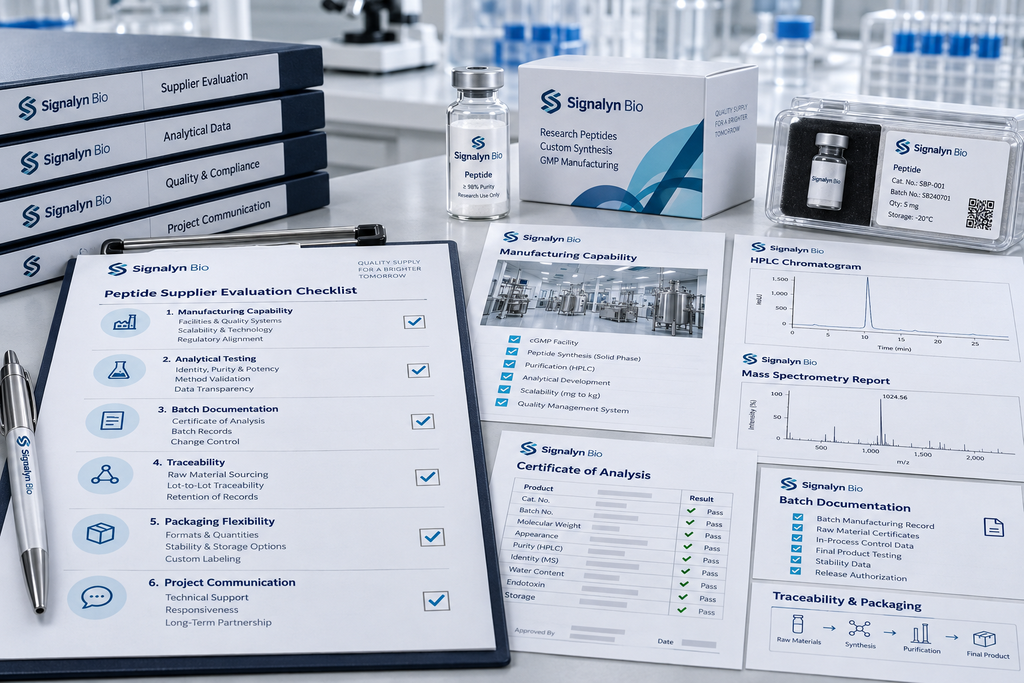
Manufacturing scope: Can the supplier support the peptide, synthesis scale, purification, lyophilization, and downstream processing required?
Purity & analytical testing: Are HPLC and mass spectrometry available, and can the supplier explain how purity and identity are evaluated?
Batch documentation: Can the supplier provide batch-specific COA, chromatograms, mass spectra, and relevant analytical records?
Traceability: Are batch identifiers, analytical results, packaging information, and documentation clearly connected to the same material?
Packaging flexibility: Can vial format, bulk packaging, labeling, storage, and handling be discussed according to the project?
Project communication: Can the supplier clearly confirm specifications, timelines, testing scope, documentation, and custom requirements before production?
RED FLAGS
Red Flags When Evaluating a Peptide Supplier
Purity Claims Without Supporting Data
A high purity percentage has limited value if the supplier cannot provide supporting chromatograms, analytical methods, or batch-specific documentation.
Missing Batch Traceability
If analytical records, packaging information, and batch identifiers cannot be clearly linked, it may be difficult to verify which material the documentation refers to.
Limited Analytical Testing
A supplier that relies on only one analytical result may provide an incomplete picture of peptide purity and molecular identity.
Inconsistent Documentation
COAs, HPLC reports, mass spectra, and product information should be internally consistent and clearly associated with the same batch.
Unclear Packaging or Project Communication
Unclear answers about packaging, storage, specifications, testing, timelines, documentation, or manufacturing scope should prompt further questions before procurement.
QUESTIONS TO ASK
Questions to Ask a Peptide Supplier Before Ordering
What purity specification can you support?
Ask how purity is assessed, which analytical method is used, and whether supporting chromatographic data can be provided.
What analytical testing is available?
Confirm whether HPLC, mass spectrometry, third-party testing, or other relevant analytical methods are available for the project.
What documentation will be provided?
Ask whether the project can include a COA, HPLC chromatogram, mass spectrum, batch identification, and other supporting records.
How is batch traceability handled?
Ask how batch identifiers connect manufacturing records, analytical results, packaging information, and final documentation.
DOCUMENT REVIEW
How to Compare Peptide Supplier Documentation
Supplier documentation should be reviewed as a connected set of records rather than as isolated files. Compare analytical data, batch information, and supporting documents for consistency.
Certificate of Analysis
Review whether the COA clearly identifies the peptide, batch, reported purity, analytical methods, and relevant quality information.
HPLC Chromatogram
Check whether chromatographic data support the reported purity and whether the sample and batch information are clearly identified.
Mass Spectrometry Report
Review whether detected molecular mass information is consistent with the expected peptide characteristics and batch documentation.
For a deeper explanation of why a single HPLC purity number is not the whole quality picture, read our Peptide Purity Guide.
FINAL CHECK
Final Peptide Supplier Selection Checklist
Manufacturing capability confirmed
Analytical testing reviewed
Documentation verified
Packaging and storage requirements confirmed
Batch traceability confirmed
Specifications, timelines, and project communication confirmed before ordering
PROJECT EVALUATION
Need Help Evaluating a Peptide Project?
Share your peptide, target purity, quantity, analytical testing, packaging, and documentation requirements with Signalyn Bio to discuss available manufacturing and quality support.